

Every Gathering a Carnival
Thoughts on radical cosmopolitanism, the authoritarian city, and the World Cup.

1.
It was the same day that Elon Musk became the first trillionaire in world history. What was he doing that day? Tweeting in support of anti-migrant pogroms in Belfast: masked men rampaging door-to-door through neighborhoods, smashing windows, burning people out of their homes, doing everything to make the city inhospitable to all but the white Protestant. This is no coincidence. Hoarded wealth has always required violence. Capitalism’s historic innovation over feudalism has been to weave a greater degree of coercion into the system. Still, behind even the most content crew of factory workers, there is always the promise of the strikebreaker’s baton. Your boss’ smile and handshake never come without a subtle threat.
Neither, for that matter, does the thanks from your landlord for your monthly rent payment. Or the wave from the school crossing guard. Even a hello from the greeter at WalMart is coded with the knowledge of what happens should you step out of line. These are the mores and patterns of behavior that swirl through between the bodies and buildings of the everyday. Constellate them all together and you have something like a town or city. On a sweeping enough scale, they become a society, the kind of phenomena we like to call a civilization. It doesn’t need to have an authoritarian shape, but in the present, it does.
Conceive of something different. Not necessarily a different shape, but certainly a different energy pulsing through it, flowing from the bottom up rather than dragged along from above. Not necessarily a slower rhythm, but less harried, less worried, less reliant on unspoken, internalized threats. A mode and pace of lives willingly and enthusiastically clustered into each other, where difference is met not with suspicion and anxiety, but with the assurance that other people are bound to enrich your life as much as you are theirs.
The city plays a critical role in this process. First and foremost, these are nodes where capital clusters, where exchange is concentrated. But where capital exists, so too must humans in some form. At least for the time being. One of the assumptions behind the quick proliferation of data centers is that binary code alone can produce capital. Which accounts for why the human cost of these centers – clean water hoarded, climates warmed, steady jobs evaporated – are of so little concern for their owners.
Cosmopolitanism, then, is very much at risk of extinction. Though labor can never be fully de-humanized, it can be alienated beyond recognition, atomizing and isolating each person’s horizon for remaking the world, exchanging ideas and histories toward that end. In the early days of Trump’s first term, Stephen Miller lambasted a reporter for “cosmopolitan bias.” The antisemitism was obvious. So was the fear of an ever-shifting, ever-widening culture and polity that can thrive on their own terms. Authoritarianism cannot tolerate this.
Most cities today are, by default, authoritarian. Deregulation, privatization, gentrification and “urban renewal,” all hallmarks of neoliberalism, has made the city a far less democratic space, less amenable to mutual discovery and recreation. Conservatives and liberals alike have accepted these as consensus. Communities, such as they are fractured and uprooted, turn further and further inward, hanging on for dear life.
What, however, could a truly borderless world look like without this cosmopolitan vision? What would a “global city” look like – truly global, not constructed of tourism branding – with its vibrant dynamisms unleashed to remake every structure and system in a chaotic, collective image?
“I frequently think about what ‘no borders’ really looks like,” writes Julia Alekseyeva, “when every individual liberation-minded person on this planet begins to (re)consider what should ‘allow’ a human to live anywhere. This is especially important in an era of climate collapse, when most studies believe that equatorial regions, and those near oceans, will face catastrophic harms, and billions will flee towards the polar regions… What if we started imagining a radical cosmopolitanism — a word whose original Greek etymology meant ‘citizen of the world’? In a universe that has always been, and will continue to be, in flux, ideological flexibility with regard to home and belonging will serve us well as a species.”
Radical cosmopolitanism. A cosmopolitan ontology that proceeds from radical assumptions, without horizontal or vertical repressions. No borders, restrictions, able to welcome “outsiders” with the guarantee of a decent life and the right to shape that life. It seems so essential to any liberatory vision, but in terms of praxis, of practical, day-to-day considerations, the left hasn’t managed to hold it up. But with the collapse of the liberal order – and its shy, spent version of cosmopolitanism – well underway, the left not only has the opportunity but the obligation.
2.
Several North American cities are dramatizing this contradictory promise. It’s been more than three decades since anywhere in the continent has hosted the World Cup, and USonians in particular are shocked – for the most part with delight – at the influx of colors and languages and sheer, enthusiastic joy.
Every team affiliation brings with it a concatenation of ideas, experiences, and memories, often highly political and almost always contradictory. That’s the nature of polysemy, and culture thrives off these wildly different definitions. For decades, many Brooklynites continued to cheer for the Dodgers, even well after their move to Los Angeles, out of appreciation for the team’s willingness to draft Jackie Robinson and break the color barrier. Conversely, descendents of those Chicano families pushed out of Chavez Ravine steadfastly refuse to root for the Dodgers. Both interpretations are valid and wholly understandable.
We can find these same colliding narratives in soccer. No cultural expression, no collective ritual, no sport, can resist converging with social reality, and from there the experiences that comprise loyalty and rivalry grow. Left-wing Colombians may feel extra pride in rooting for their squad at the World Cup since Petro came to power (a pride that will likely continue should Iván Cepeda win this weekend’s election), but this didn’t necessarily stop them from cheering in 2022 when conservative Iván Duque was president.
This may not play out the same way in, say, England, where the St. George’s Cross – reinterpreted across the jerseys of the national team – has long been wholly claimed by the Faragist/Robinsonite right. I’ve yet to meet anyone on the English left who gladly cheers for their team. Some go so far as to root for anyone but England (probably an easier stance to take with Scotland back in for the first time since ‘86.)
Now, on top of these interpolations of class and nation, place the faultlines of empire and racism. Some refuse on principle to side with the French team when it faces off against that of its former colony Senegal. For others, the multiracialism of France’s squad – and the way this has historically rankled the country’s far-right – is enough to earn their loyalty. With the Democratic Republic of Congo in the Cup for the first time in fifty years, some relish the (remote) possibility of a matchup with Belgium: the potential for revenge against King Leopold’s ghost, complete with a stern and dignified Lumumba mascot.
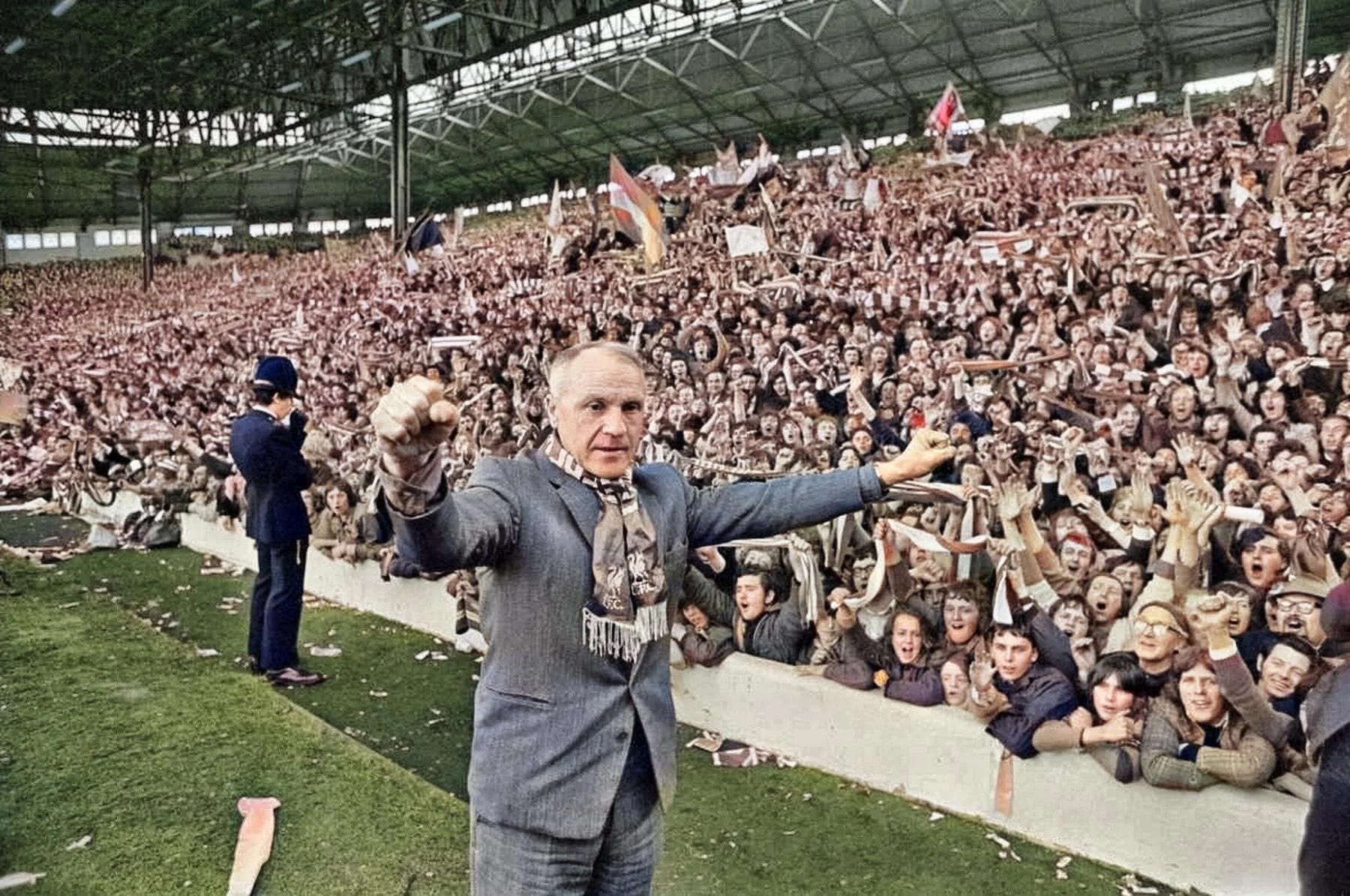
Read Galeano’s Soccer In Sun and Shadow and you can see the strange permutations of love and pain this game embodies, the deep hopes ordinary people pin on it, losses far more devastating than the scoreboard shows. Why do so many identify so fiercely with their local or national team? Even for the most conservative, there is likely at least a hint of the great Bill Shankly’s definition of socialism: “everyone working for each other, everyone having a share of the rewards.” In a world that denies comfort and satisfaction at every turn, the catharsis of an emotional reward can be quite alluring, and it isn’t always a mirage.
We can’t dismiss how meaningful it is for American soccer fans to comingle and celebrate with their counterparts from Scotland, Ghana, Portugal, Croatia, Uruguay. To hear and experience narratives and histories made manifest in the revelry. We can’t, however, forget that there are other forces at play. Culture from below is met with culture from above, transforming the former into something other than itself.
One of the companies most persistently injecting itself into the fabric of the World Cup on television is AirBnB. Their ad, practically playing on repeat during the streaming of matches, goes like this:
Did you know salsa was invented when Puerto Ricans took Cuban rhythms to New York? Brazilian jiu jitsu was born when the Japanese took judo to Brazil. When North African frying traditions met Spanish dough, Spain made the churro. After Jamaicans took their sound systems to the UK, the world got punk. And this? This is what the world gets with 48 nations meet for one beautiful game.
Cue the chorus riff for the Beatles’ “Come Together.” Rent a spot from us and participate in the beautiful exchange, the ad tells us. What culture will be left if AirBnB has its way? Will locals be able to afford rent in any desirable areas if short-term rental apps like them keep driving up prices? Who, in this scenario, is able to afford the beauty of cultural exchange? At what point does cosmpolitanism from above simply become something other than cosmopolitanism? Is such a cosmpolitanism simply standing in for the authoritarian lifeworld?
“Football unites the world” goes the FIFA slogan. A lovely sentiment, but when the greatest football tournament in the world is being held in a country currently sending back fans from Haiti, referees from Somalia, and players from Iran, it comes across as sanctimony.
3.
There are, thankfully, other models of urban governance on offer, parting with the failures of the neoliberal city. In the US, a growing number of cities – most obviously New York, but also Seattle, very soon DC, and possibly Los Angeles – are electing mayors who self-identify as democratic socialists. And we can’t ignore the already auspicious number of socialist city councillors. There are undeniable limitations on socialist municipalism in bourgeois democracy. One cannot conceive of urban liberation through purely electoral means. Nonetheless, the idea that our daily lives can exist outside the realm of the commodity, that ordinary people can rely on each other to build that life out, is palpable.
One of the limitations, however, has recently become apparent in recent days. Zohran Mamdani has largely sidestepped his commitments around policing since becoming New York’s mayor. It is, to be fair, understandable. The NYPD have killed mayorships before. There’s a certain logic to focusing more on his social welfare agenda like municipal grocery stores and free childcare before taking on the cops. Still, agreeing to an outright increase in the size of the city’s police force – adding more than 500 officers – is rightly raising some eyebrows among his most fervent supporters.
A thriving, equitable city, a city open to being revamped and reinvented by its own throngs of people, has maximized the possibility for free movement and assembly. It has minimized, if not eliminated, the places that people cannot go, the diktats that tell them how they can occupy these places. It has abolished the idea that some can go here and some cannot. In other words, the opposite of what cops do.
Mamdani certainly knows this. It very well could be that he hopes his victories on the front of making this city more affordable can leverage the kinds of movements needed to tackle the infamous and thuggish NYPD. That is a gamble, and a risky one at that. The fatal flaw in attempting to forge a thriving cosmopolitanism only through traditional channels is that the fully actualized cosmos has no inherent respect for the boundaries of tradition.
Look at the histories of cultures colliding in their most potent form and you’ll likely see the kinds of tremors that surge past the permission of institutions like police. From hip-hop in the Bronx to the actual crossovers between reggae and London’s nascent punk movement. Yes, the first punks were enthralled with Jamaican acts like Prince Far I, the Melodians, and more homegrown bands like Aswad and Steel Pulse. This meeting of different meanings was a volatile one, though, and it was this volatility, this existence without permission, that led directly to the most enduring musical examples. Joe Strummer and Paul Simonon just happened to be at the Notting Hill Carnival on the day when the Metropolitan Police’s harassment of young Caribbean youth finally proved too much. Famously, the events of the day, a full-on uprising where young people threw rocks and bottles at cops and set several police vehicles on fire, was the inspiration for the Clash’s first major single “White Riot.”
Though the song’s lyrics bemoan the lack of militancy among white youth seen among their black counterparts, there is also an unspoken commonality: 1970s Britain would not allow any subaltern culture to take root and grow if it wasn’t prepared to stay in its place. The problem is that no cultural expression can take root and grow while “staying in its place.” It must transgress, must edge its way over boundaries and limits. Bakhtin knew this.
We end, ultimately, imagining two torn halves together. A radical cosmopolitanism worthy of its name needs to flourish of its own accord, but this doesn’t necessarily mean it need always be in opposition. On the contrary, the aim of any such counter-culture is to become the dominant culture without losing its dynamism, its collective liberatory vocation. How can we conceive of something like the constant influx of cultures and narratives now flowing through American cities, the excitement it evokes in the masses as a whole, without the threat of the nightstick underneath it, the false promise of freedom through spending? It is difficult, but we can say for sure that it won’t be summed up in a housing rental ad.
Header image is of former Liverpool FC manager Bill Shankly (1973).