

Human Project
Acid communism, family abolition, and reading Sartre at my son’s birth.

And why, you ask, have I been absent from this platform for the past two weeks? Read on, dear reader, read on…
One quick note: moving forward, new posts will now be coming out on Wednesdays. There is also, hopefully, an increase in frequency in the works.
(Also, given the above and the below, and given that baby always and forever needs a new pair of everything, now might be the time to sign up for a paid subscription.)
Our son was born on May 28. We named him Brecht. He showed up between the closing notes of the Pixies’ “Here Comes Your Man” and the fade-in for New Order’s “Temptation.” And I never met anyone quite like you before. And I haven’t.
What they say about the difference between who you are before and after you become a parent – imperceptible but dramatic, felt on every level, where you’re rendered unrecognizable and yet, somehow, more yourself than you’ve ever been – is absolutely true. Two weeks later, I still find myself marveling at Brecht’s face, the way his eyes explore his tiny world (infants cannot see more than about ten inches in front of them for their first month). What goes on in his head? How is his new brain taking in the world around him? What is a consciousness like in its initial moments of formation?
When people ask if I’m concerned for what’s to come in his life, I answer no, I’m absolutely terrified. The best essay I’ve read on raising children in these futureless times was written by Sarah Grey in the pages of Salvage. She describes driving through the Florida Everglades with her then-seven-year-old, just a few months before the landfall of Hurricane Irma. Both are aware of how rapid (sub)urban development has reduced this complex and delicate ecosystem to half its size. Neither can tell when the next disaster will come, but both know it will. In Grey’s words, it feels like driving through
the ‘cone of uncertainty’ – that brightly coloured funnel on the weather map that traces the possible paths of a storm. It’s a statistical mishmash created from dozens of predictions of varying quality, and when you see the dark red centre touch your part of the map, you can almost feel the barometric pressure dropping. You might have days to prepare, days before you know whether it’ll really hit you and how badly. You might not have days to get out, not if the roads are clogged and the gas stations are mobbed; certainly not if you have to work and don’t have cash on hand. You hunker down as best you can, waiting for the first rainbands and the next, for the eye to pass over and the eyewall to return.
This essay was written almost nine years ago. We know the feeling the author describes well, whether we acknowledge it or not. Eight years ago, the IPCC report told us we had twelve years to stop climate change. It was a conservative estimate. The Everglades themselves host the now-notorious Alligator Alcatraz migrant concentration camp. Little has gotten better. The prospects for a meaningful future are, if anything, dimmer than they were when Grey wrote. Still, my wife and I chose to have a kid. Futures aren’t simply lived in and inhabited. They are actively made. Or at least they can be.
Having a child today is to bet on the latter outcome, which itself is predicated on transforming the current inertia sliding us toward catastrophe. What some call foolhardy is in fact a quiet act of hope in a setting of extreme hopelessness. Every parent, whether they know it or not, is uttering the final words of the narrator in Samuel Beckett’s The Unnamable. “You must go on. I can’t go on. I’ll go on.”

Whenever I’m not agog at my son’s very existence or fretting for his future, I’m mostly in awe of my wife. Some enjoy pregnancy, others don’t. My wife was in the second category. She likened the process and feeling of making a human in her belly to a body horror film. Having her body hijacked, another lifeform snatching up resources and energy to gestate its limbs and brain, heart ventricles, bronchioles and lower intestines. The body aches, the late-night leg cramps, the mucus, the excess blood, the inability to get comfortable, the unpredictable bowel movements. Cronenberg shit. Literally. And nobody thinks this harder than my partner, who, admirably, wore it all with humor. It will all be worth it she refrained. And so far, it has been, for her and for me.
I find my thoughts drifting back to the nurses and doctors who ushered my wife and son through the process of bringing him into the world. There are some truly remarkable people working in healthcare, keeping hospitals going, not just saving lives or making them better, but arguably making the conditions necessary for life in a complex society into a reality.
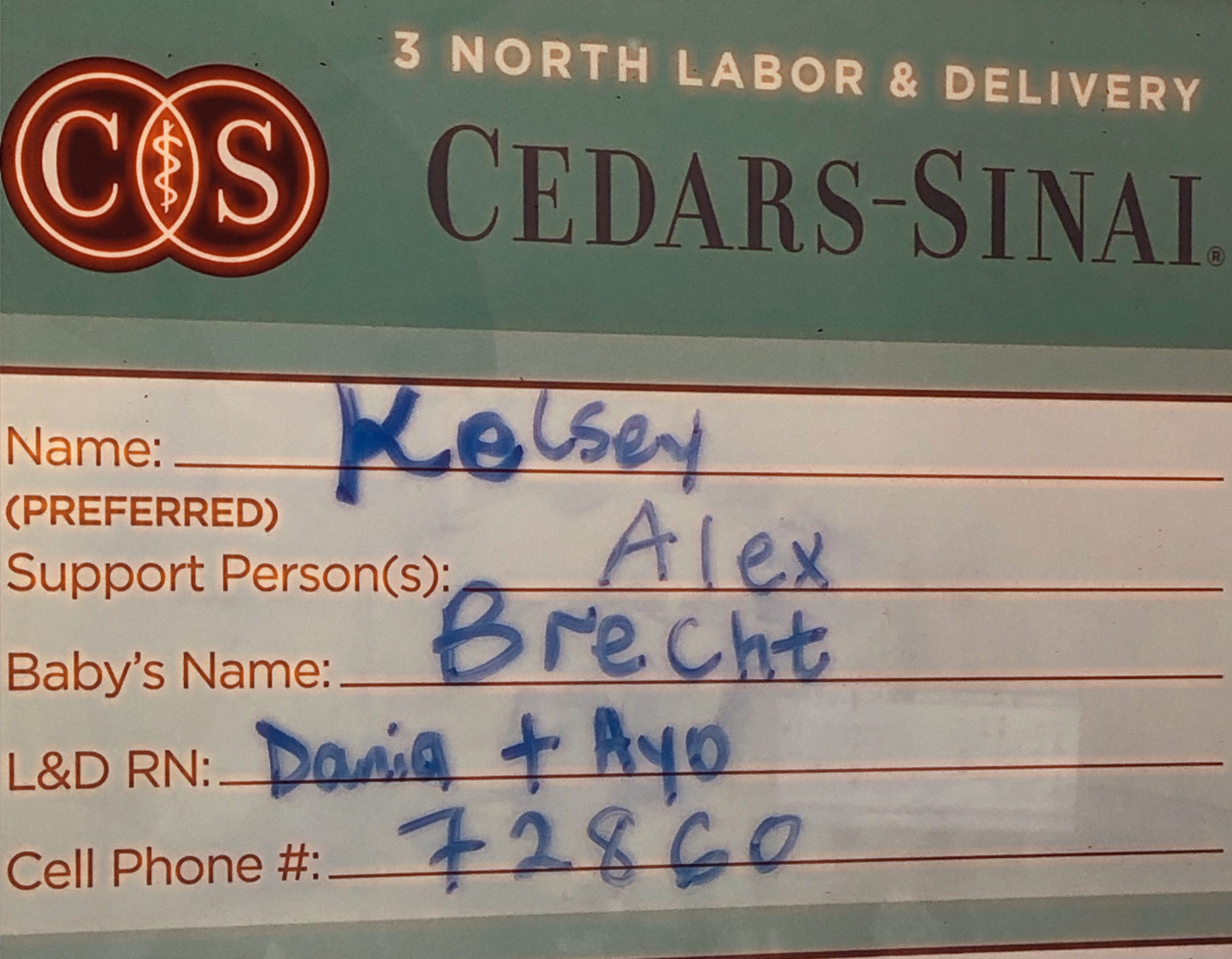
We showed up early in the morning, but knew we were likely in for a long labor. Many of the nurses and doctors had already been on shift for hours on end. Still, they cared for my wife and the baby with profound attentiveness, know-how, and a touching sense of humor. It didn’t hurt that my wife is already one of the most gregarious people you’ll ever know, which was soon amplified by some very potent painkilling drugs. These are people doing their best – and, in our experience, mostly succeeding – to remember that each patient has unique needs, often running counter to the needs of insurance companies.
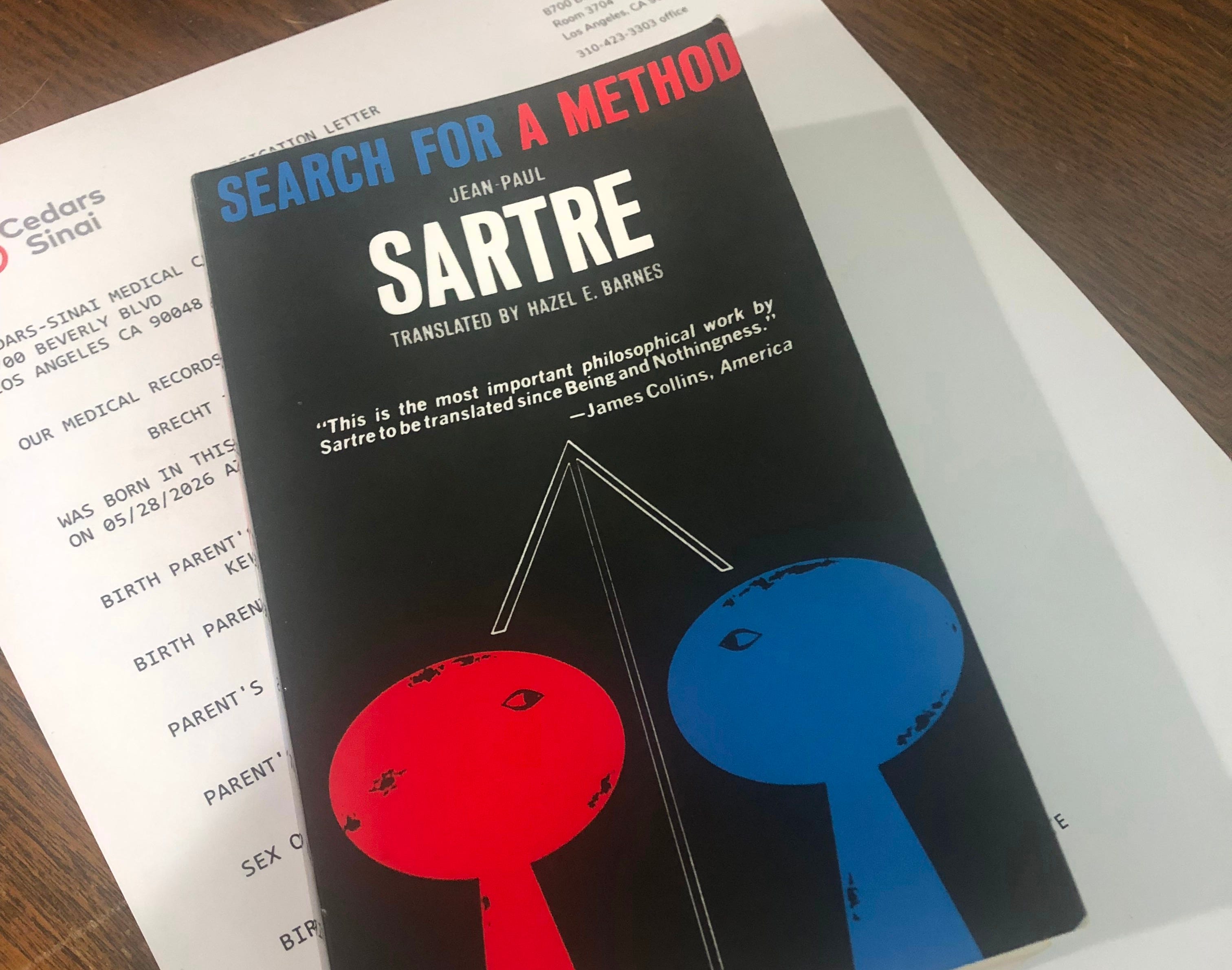
Because we would be there for a couple nights, and because we knew there would be long periods of downtime after delivery, I brought reading material. Not particularly unusual, though apparently the choice of subject-matter was. “Wait, you’re reading that?” asked the nurse, pointing to my copy of Jean-Paul Sartre’s Search for a Method. Turns out she studied philosophy before switching to nursing.
I can’t deny that it was a strange choice, but to be fair, I wasn’t about to start an entirely new book. I also knew that, though my attention would need to largely be on my wife’s needs, there would be long stretches of downtime after the drugs kicked in and we waited for ten centimeters dilated.
Written in 1957, and later serving as the introductory essay for his Critique of Dialectical Reason in 1960, Search for a Method is probably the best encapsulation of how Sartre fused his philosophical outlook with his revolutionary political commitments. For him, there was no contradiction between his existentialism – the search for a free and authentic life in the face of absurd existence – and the precepts of Marxism.
One could easily mistake how they might be in contradiction, particularly given how calcified official communist organizations had become by this point, how reliant they had become on rote dogma and cant masquerading as analysis. Sartre had watched the USSR crush the Hungarian revolution in 1956, seen how unwilling most mainstream, Stalinized communist parties had been to even consider that something had gone awry in their framework. A truly liberatory vision of socialism would require the kind of fearless probity and patient willingness to examine the specificities of every event and phenomenon, rather than fall back on rigid “prefabricated molds” that led many to cheer on everything done in the name of the Soviet Bloc.
This flexibility, aimed toward helping the thinker identify reality’s explosive potentials for what they were, was something that, in Sartre’s view, Marx himself reached for. Much had happened since. Reliance simply on class conflict without regard for the mediations ideology and psychology – themselves shaped by the dominance of capital – was bound to fall short in explaining the contingencies of human activity.
Humans are driven and pulled to certain actions, and these actions aren’t always “because capitalism,” or at least they aren’t apparently so to the actor. Freedom, the conditions for each profoundly unique human being to develop themselves, requires a society that understands the need for what Sartre calls the project. Simply put, this project is the way a human propels themselves toward the future, internalizing desires and urges and hopes into a motivation to move. “Man defines himself by his project,” writes Sartre.
This material being perpetually goes beyond the condition which is made for him; he reveals and determines his situation by transcending it in order to objectify himself – by work, action, or gesture… this perpetual production of oneself by work and praxis, is our peculiar culture.
And what comes between the human and their individual motivation, this praxis, this “peculiar culture” distinct to the human project? To be brief, it would seem that everything which conditions us to accept life as an experience nasty, brutish, and short. The struggle for meaning and the struggle against class society are ultimately co-constitutive. The resulting challenge is in the formation of a human subject fully capable of shaping and reshaping themselves, and facing the systems that prevent them from engaging in this praxis.

The ways this plays out in the initial stages of childcare are stark. Full development – from each according to their ability to each according to their need – is impossible when the conditions of lifebuilding are so sparsely provided. To look at how childhood is infused into our cultural landscape, however, you wouldn’t guess it. Moving through the world of late capitalism means being bombarded with what we are to believe are the necessary accoutrements of childhood.
Children’s cartoons, toys, and theme parks take up a large part of our attention. We are inundated with advertisements for commodities, services, and experiences that often don’t even present themselves as advertising. Increasingly, they don’t need to. They are just there, around every corner, along the sides of every website, waiting for the algorithm to point the way, exuberant soundtracks and bright colors in accompaniment. The child wants, and they want strongly, fiercely. Of course it’s not the child’s money that the advertiser is looking to suck into their coffers; the child has no money of their own. But even the most destitute parent has a hard time enduring their child’s disappointment.
Given this proliferation, you would think the tools for raising a healthy child are easily within reach, but we know that’s not true. The practicalities of bringing up another human being – developing their emotional, psychological, and intellectual selves – are substituted in the public consciousness with knowledge of childhood as individual consumption.
We can name at least one of the dogs on Paw Patrol, but can’t teach each other how to swaddle a newborn. Virtually every space is “child friendly” or “family friendly,” but responsibility for the child falls on the individual parent who, should they be unable to afford full participation, will likely be shamed out of or simply prevented from accessing the space. The irony is that the lack of spaces to freely cultivate and learn about childhood stunts the most clueless – particularly those subject to the trappings of masculinity – transforming them into children themselves.
There are stories bouncing around Reddit threads of men showing up to their partners’ labor with home gaming systems, asking the nurses how to hook them up to the TVs in the delivery room. Sure, in the abstract there’s nothing differentiating one way of passing the time from the other as parents wait for the time to really start pushing, though this assumes a complication-free delivery. Without making a highly gendered assumption about video games, and notwithstanding my bias for reading, a gaming system presents an evident tripping hazard for doctors, nurses, and other hospital staff at a moment when there’s a lot going on and time is of the essence.
Images of clueless man-children obliviously fiddling with their controllers to the sounds of Call of Duty while their wives strain and push through the herculean pains of delivery understandably come to mind when we read these stories. How could they not? We can’t ignore that most young men today see child-rearing as an isolated series of tasks, divided from other forms of labor through the convenient prisms of “woman’s work” and “real work.”
Those who do the caring work of social reproduction don’t have the resources they need, even in those fields like nursing that are nominally considered “real work.” The care we receive as a whole is impoverished. People alienated from their own childhood selves raise another generation of alienated kids. Generation after generation spends their lives trying to “heal their inner child.”
This process – one of almost immediate alienation and spiritual impoverishment – fits into a broader need vis-à-vis capital and children. It’s not merely that children are levers to squeeze more profit from parents. It’s that they are future laborers, and this potential reaches back to shape and fit both child and parent to make them suitable for such a teleology.
“As present and future laborers, children also participate directly in the processes and institutions of social reproduction,” writes Sue Ferguson. “To begin, they are the objects of the (feminized, gendered, and racialized) reproductive labor of others. But they are also agents of their own self-transformation into capitalist subjects – subjects, that is, who are both able and willing to both sell their labor power for a wage, and who over time take increasing responsibility for their own social reproduction (and possibly that of other people, too). Whatever else it may be, childhood under capitalism is incontrovertibly the space and time in which such a transformation is set in motion.”
We are obligated to consider what this subject formation would look like beyond the limits of capitalism, in excess of labor as a means of extraction. Sartre writes of the unavoidable need to see one’s human activity reflected back at them. He calls it an “objectification” (at least in Hazel Barnes’ translation), and in the case of the physical objects we make it is apt. For humans? Perhaps not, but there is a lot to be said in seeing a future you set in motion in a child’s eyes; not a future you jealously keep, not even a future you’re guaranteed to see, but one you dream into being. The atomic unit of subjectivity as a collective endeavor.
What kind of world would result if caregivers had the resources they need, and if that care was considered a right rather than a privilege? What if caregiving writ large was considered a collective project? Would the inner child still require healing? The space and time of childhood can hold potential for completely different kinds of transformations.

Keeping all of the above in mind, and with only a couple weeks’ experience under my belt, my instinct is that fatherhood has made me more of a family abolitionist. Not less of one. Provided we understand the abolition of the family for what it is, apart from its detractors on both the right and the “class first” left. Family abolition isn’t about yanking children from their parents’ arms, legally prohibiting people from knowing who their siblings are, or mechanizing human reproduction into anonymity. It is about understanding the historical contingency of the family form and expanding its borders, its practical horizons of care and love, and how the privatization and commodification of social reproduction have diminished those horizons.
It is, subsequently, about obliterating these conditions. Purging the repressions, resentments, and petty violence that fester in the privatized care unit, allowing for preexisting loves to flourish and new ones to come into being. It’s a scary prospect for some. Here’s Sophie Lewis:
Of course, any family-abolitionist worth their salt understands all too well that the ‘infamous proposal of the communists’ – to abolish the family – attacks the very foundations of the self (as currently constituted). I think the psychological reaction-mechanism – and it’s one all of us must contend with – goes something like this: ‘Well, sure, it may be a disciplinary, scarcity-based trauma-machine, but it’s my disciplinary, scarcity-based trauma-machine! And I don’t know who I would be without it! Back off. How dare you’. In other words, the idea of abolishing the family triggers enormous onto-epistemological anxiety, whereupon a violent anger is often unleashed.
Social fears become personal. Confronting them means partially confronting the self, or what we think the self is. For this reason, becoming a parent – facing the gap between the possibility of flourishing love and the present reality of anemic care – has proven to be a profound and, surprisingly, psychedelic experience. Psychedelic in the Marcusian sense: not down to the use of different hallucinatory substances, or hallucination instrumentalized for the sake of mere fun, but your emotional limits radically rearranged as your position in social need starts to change. As the demands of care required for raising an infant come into focus, your insecurities and convinced shortcomings shrink in context. The faults you’ve overthought into permanence are no longer an excuse. You just have to remind yourself you entered into this moment voluntarily, enthusiastically, knowing unfair obstacles are waiting for you. To care, to love, are paramount. The rest is irrelevant.
Interestingly enough, and like it or not, this does involve substances of a sort. The body of a person giving birth is flooded with adrenaline, more than they’ll ever likely experience again. The flood won’t abate for four or five days. Same for the baby. Simultaneously, their levels of oxytocin, the hormone that boosts feelings of euphoria and wellbeing, fly through the roof. This will also remain elevated for several days. And whether you’re the one giving birth or not, the experience of seeing and holding your kid for the first time sends your oxytocin soaring. Every time you hold them, particularly skin-to-skin, you get a spike. Now add in a dramatically new and erratic sleep schedule. Your armor of habits and thought patterns weakens. You grow and open yourself to love because you have no choice.
What happens to our consciousness during these moments? How, as our minds open up to a new valence of unavoidable connection, do we respond? Plenty of people choose not to, or to view parenthood as a form of ownership rather than a bond of nurture. Or they simply see nurture and ownership as interchangeable. Responsibility simply becomes coercion and control. When you’re in my house, you’ll obey my rules. Because understanding and being convinced isn’t a privilege we extend to our possessions.
It’s easy to fall back on this approach. If only because the relationship between possessor and possession is one of the fundamental ontologies of our world. We expect kids behave a certain way, to grow into a certain mold; the same expectation we have of the manufactured commodity. Finding a different, more human and egalitarian approach requires taking a leap beyond the horizon of the what is. Embracing the specter of a world that would be free.

The first person at the hospital to recognize the origin of our son’s name was the lactation specialist who visited the day after his birth.
“Brecht? As in Bertolt Brecht? Caucasian Chalk Circle?”
“Yes, are you also a theater person?”
“No, but I’m from Europe. We learn about him like you learn about Mark Twain.”
She seemed surprised, mostly because Brecht’s plays are so bleak. They are of course. They also point to the gothic realities, the haunted practices that keep capitalism slouching through history. The Caucasian Chalk Circle famously tells the story of a peasant woman who, rescuing a baby abandoned by its aristocratic family, becomes a better caretaker than the biological mother. She then has to defend her right to raise the child against the wealthy mother when the latter returns to claim it for her own and thus fulfill an inheritance requirement. The play asks whether motherhood – and, for our purposes, any kind of nurturing care – is a matter of biology or the decision to truly care and sacrifice. “[W]hat there is shall go to those who are good for it.”
In other words, whether the best of what we understand family is actually intrinsic to what we understand as family. As for the love, the level of care provided by the peasant Grusha, it’s never so present in Brecht’s other works. Though Brecht’s daughter, Barbara Brecht-Schall, remembers him as a devoted father. In his poetry, love stalks at the edges of every cruel disaster, waiting for the chance to emerge.
His poem “My Young Son Asks Me” sees the titular son asking Brecht those questions any elementary school teacher is used to hearing. When will we use this? “Must I learn mathematics?” “Must I learn French?” “Must I learn history?” At first, Brecht replies with resigned cynicism. Why learn more than you need to survive, to get your hands on the bare necessities of food and shelter? Maybe sticking your head in the sand is the best way to ensure a future.
Abruptly, and at the very end of the short poem, Brecht changes course. “Yes, learn mathematics, I tell him. Learn your French, learn your history!” He does it without explanation. Because we don’t love for the sake of survival, resigning and settling in the face of uncertainty. Love’s very nature, as a state of mind, cannot tolerate the rote prose of “just enough.” Even in the face of apocalypse, it expands too quickly, reaches far too big a size to be contained. What does it demand? Only the world.
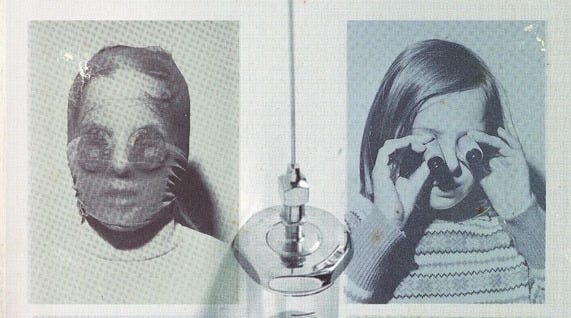
Header image is from Children and Hallucinogens (2013). (For the record, not a real book…) All other images are by the author.
Worms of the Senses
(what I’m seeing, hearing, and reading…)
Seeing
Death by Lightning, written by Mike Makowsky, directed by Matt Ross (2025)
Hearing
Boards of Canada, Inferno (2026)
Shame, Songs of Praise (2018)
Reading
Universal Harvester, by John Darnielle (2017)
Congratulations on your addition to the biosphere's constellation!
Fascinating read. Congrats on Brecht!