

Inward Anarchy
A pulp-punk masterpiece, spooky materialism, and whatever "adult punk" is. Worms of the Senses for July 6.

First things first: I’ve got a poem up on the Locust Review website. It also appeared in the print issue this past spring. Give it a read. It’s on how easy it is for the worst and most murderous tendencies in late capitalism to wrap themselves in righteousness. It seems an interesting foil for last week’s poem here at To Whom It May Concern…
Also, there’ll be a bit of a change in schedule this week. Today we have, as per the new usual, “Worms of the Senses,” our weekly feature where I run through the best things I’ve seen, heard, and read over the past several days. There will be no Thursday article on the 8th. Instead, this week we will have two essays, on Wednesday and Friday.
Wednesday, we will take a look at the peculiar – and peculiarly ridiculous – form of spectacle that descended on Washington DC these past several days: the cheap, flabby, still-gestating aesthetics of American proto-fascism by way of Trump’s 4th of July.
Friday’s essay will be for paying subscribers only, and it will be a bit of a deep dive into my latest object of fascination: Alex Cox’s sci-fi punk noir Repo Man. The film’s idiosyncratic method of storytelling, its portrayal of cosmic-urban apocalypse, the past state and current fate of punk, the affinities between the punk genre and noir, and a bit of a revisit to some of the film’s sites in Los Angeles; all are the subject matter of the essay. (There’s something of a teaser below…)
Though a preview will be available to all subs, if you want the full experience, you’ll have to cough up a few coins. A regular sub is only $6 a month, and it goes a long way toward funding the kind of work I do at this blog.
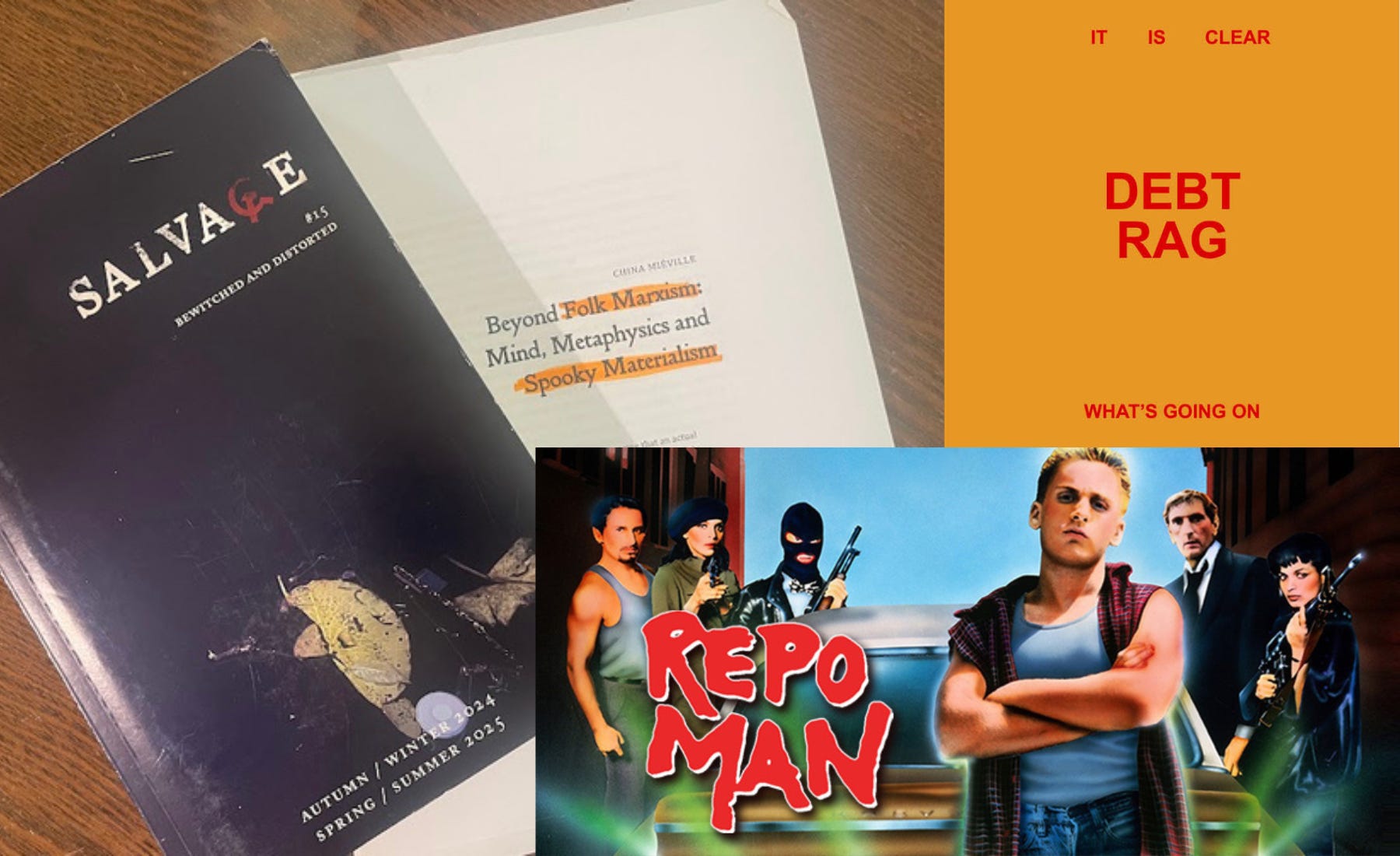
Repo Man, written and directed by Alex Cox (1984). Easily one of the greatest punk films ever made… and somehow I hadn’t seen it until now. Campy, silly, melodramatic, scuzzy and scummy and schlocky and cheap and goddamned brilliant.
Yes, it’s basically B-movie pulp, noir repurposed for the 1980s. Hapless punk Otto (Emilio Estevez), recruited as a car repossession agent by Bud (the great Harry Dean Stanton), drifting through a crisis-ridden Los Angeles while searching for a car with the body of an alien in the trunk. But a lot of the story – specifically the story of what LA, and the world, have become – is told through what happens in the background, or in the moments of offhand banter.
And yes, it’s a punk movie par excellence. The score’s written by Iggy Pop. The soundtrack includes Black Flag, Suicidal Tendencies, and the Circle Jerks (who play a bad lounge band, and Zander Schloss, who would join as a bassist in 1985, plays “Kevin the Nerd”). The kids wear ripped jeans and mohawks and start mosh pits in back alleys. They’re also all, bar Otto, intensely stupid. There’s a sense of love for punk here, but also that the movement had hit a wall, that it wasn’t up to the challenge of facing down Reagan’s USA.
It wasn’t of course. Not just because art isn’t politics and no musical subculture can change the political landscape on its own. And not just because the pressures of mainstream American culture were being brought to bear on a movement that was, by its nature, volatile and unstable. (Though both of these are true.) The seeming invincibility of Reaganism produced an existential sense of malaise and dread among those horrified by AIDS, by intervention in Central America, and by the crushing of people’s livelihoods.
Among many other outcomes, it forced oppositional subcultures to turn inward. When subcultures do that, when they retreat from the possibility of broader change, they start to fancy themselves an escape in and of themselves. It’s not hard to read that into the ending of Repo Man. Everything falls apart, resistance becomes a fool’s errand, everyone sets out to get theirs and only theirs, wouldn’t you grab the opportunity to float away in a glowing car?
Debt Rag, It’s Clear What’s Going On (2026). Debt Rag like to refer to themselves as “adult punk.” I don’t quite know what that means, but it bears mentioning that the band’s members didn’t append that title to their previous project, the Bay Area-based Wet Drag. The two bands have much in common: the same basic lineup, unorthodox arrangements and structures, short song lengths.
Debt Rag, in the most obvious difference, lack guitars on their songs. The harsh, dissonant sonic abrasion is performed, in most of these songs is taken up by fuzzed-out keyboards, blaring trumpets. The shrieked lyrics are a kind of absurdist reprocessing of the everyday mundane. The three members aren’t just having fun with their instruments and voices but with what happens to their deliberate crudeness when they have access to recording equipment.
But what of the “adult punk” designation? Is it just the fact that they aren’t playing guitars? It’s definitely something more. The trope of the punk who grows up and has to get a job is well-worn, but it doesn’t normally lead anywhere. Either the punk “sells out” and gives up their ideals, or they stop growing creatively and freeze their musical output in place. Except that your grown-up years, your parent years, when the pressures to fall in line are there greatest, are when one most needs a creative egress. Not outlet. Egress.
I’ll quote at length from Martin Douglas’ KEXP piece on Debt Rag’s previous album, Lost to the Fantasy. I think it goes just as much for It’s Clear What’s Going On.
I’ve exhausted a lot of space on this website and elsewhere decrying the influx of young professional normies into the ecosystem of independent music, but what about the young professional weirdos? What about those of us who plow through soulless and boring day jobs, avoiding questions about our writing or our bands or our hand-sewn quilt coats, or our paintings? Those of us who try our damndest to not put every bit of ourselves into earning a living so that we can enjoy being creative and putting something into the world that is offbeat and meaningful? Something that adds beauty to the world or makes people think? Something other than the fucking goddamn soul-draining deluge of “product” and “content”? Debt Rag makes music for those people. Us people.
“Beyond Folk Marxism: Mind, Metaphysics, and Spooky Marxism,” by China Miéville (Salvage, 2025), “Their Materialism and Ours: Minds, Matter, and Marxism,” by Landon Frim and Harrison Fluss (Salvage, 2026). From the retreat inward, perhaps we’ll find the key to return to the external world’s transformation. Having read Miéville’s article not long after it came out – and followed his and Richard Seymour’s provocations about Marxism and the nature of consciousness – I naturally needed to read the reply from Frim and Fluss. But this in turn meant I had to refresh my understanding of Miéville’s arguments. It’s been helpful, partly because my own present work on modernism pivots from an insistence that the left hasn’t satisfactorily engaged with “the hard problem of consciousness.” This has ramifications for how we approach questions of art and radical social change.
The debate has been a compelling one to read, but ultimately, for as lucid writers as Frim and Fluss are, they haven’t shifted the debate in the end. To their credit, they greatly clarify the stakes of the debate. And their elucidation of Spinoza’s conception of God is hugely edifying: a God unswayed by human intervention, wholly idealist and therefore (and here’s what’s provocative) indistinguishable from thoroughgoing materialism. It is also refreshing to see them agree that metaphysical questions can’t be ignored by Marxists. In the end, they choose to avoid the question, moving from the “hard question” to the “fundamental question.” Consciousness solely down to material conditions. A dodge. And it shows when they impose a stance on Miéville: that consciousness comes from God. Which Miéville never actually suggests, even while tagging in the work of David Bentley Hart and Ali Shariati.
Bluntly, as someone who (provisionally) identifies with the more existentialist strains of Marxism, I find Miéville and Seymour’s arguments far more compelling. If only because they are apophatic. They admit what they can’t quite grasp. Which every honest materialist must. If absolute idealism is coterminous with materialism, then admitting we don’t have a fulsome explanation for why consciousness arises behooves us. It allows us to explore possibility, to admit that the universe is open and that its laws (including those undiscovered by human comprehension) do not close it off. Possibility must be a cornerstone of Marxist materialism. How does it change? How does it move? We may not always have a ready-to-reach answer. Insisting we do seems, to me, to blind us to that possibility.
Header image is of Salvage #15 (photo by the author), promo image for Repo Man (1984), and cover art for Debt Rag’s new album (2026).