

Oceans Against Overwhelm
Weaponizing calm, in the right direction.

An interesting snippet from a piece in the Guardian today:
Across TikTok and Instagram, videos centred on [Mark] Rothko’s work are accumulating hundreds of thousands of views. One creator has begun styling outfits inspired by individual Rothko canvases; another assigns Rothko works to personality archetypes, describing Untitled (Yellow and Blue) as a match for “someone who wakes up early, drinks citrus water and has their life together – or at least looks like it”. Elsewhere, users compare his atmospheric palettes to the hazy melancholy of the Cocteau Twins – the dream pop band also undergoing a gen Z renaissance right now. As one young creator put it recently: “Date idea: me, Rothko, and nobody saying ‘I could have done these.’”
No mention of Rothko’s politics, or the role they played in his famous, oceanically monochromatic experiments on canvas. No mention that he was a leftist for much of his life as a painter, a member of the Industrial Workers of the World, and that he maintained left-wing commitments after disassociating himself from Stalinism in the 1940s. Nor that he intended his now-famous “multiforms” — emblematic of modernism — as a nose thumbed in the direction of modernity’s need to commodify anything and everything. The stereotypical links between abstract expressionism and Cold War American cultural propaganda simply can’t fully account for artists like Mark Rothko.
How can you commodify a color? his paintings seem to ask. Or the vast feelings evoked by it? Even after his wild success in the 1950s, Rothko probably didn’t anticipate the way in which these provocations could be so easily absorbed into the spectacle of “the art world,” modern art as a marker of status. He wouldn’t have guessed one of his paintings would one day sell for $85 million. Or maybe he did. Maybe that was part of the point.
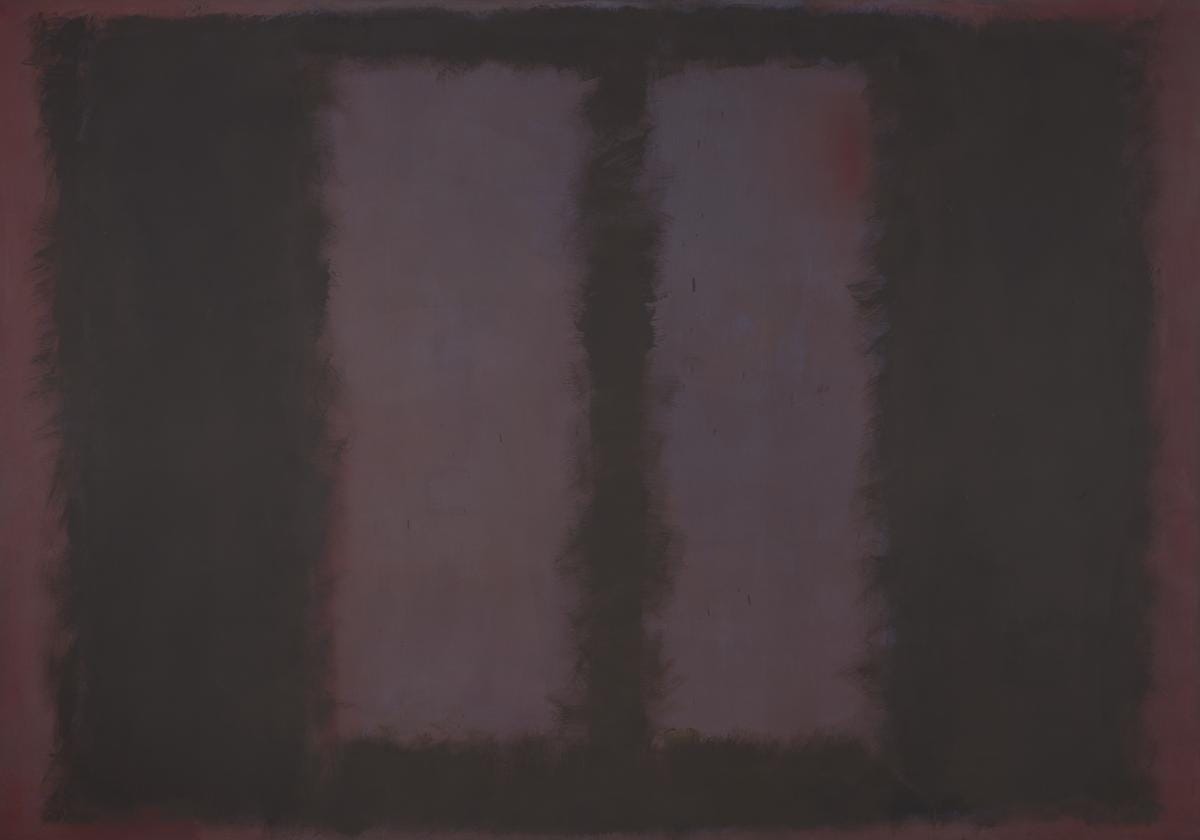
What matters here are the “atmospheric palettes,” the expansive, edgeless worlds that Rothko’s paintings draw us into, and the contrast drawn between these and the current one that drives a railroad spike into our attention, our sense of self, and our connection to something universal. That younger people see in Rothko’s paintings a retreat from the overwhelm of daily life — its constant chaotic promises of more chaos — is a very salient indicator of their collective ontology. However, the short article seems to frame its dichotomy between spacious calm and media bombardment as finding resolution through retreat, in a frankly Catholic context.
Two exhibitions of Rothko’s work are mentioned in the article. One is the Rothko Chapel in Houston, commissioned by Dominique and John de Menil — patrons who, the article’s author Nadia Anwar-Watts specifically mentions, were devout Catholics. She also mentions the multi-site exhibition in Florence, which puts the artist’s work in conversation with the 15th century friar and painter Fra Angelico.
Anwar-Watts is of course under no obligation to bring up Rothko’s leftist commitments. Along that same line, it is also naive and narrow-minded to deny the spiritual dimension of the mindsets invoked by his paintings. To frame the “gen Z” love of his art as “merely” cultural, however, leaves something troublesomely unexamined. It portrays the art as a retreat from modernity’s chaos, rather than the demand to go through and achieve a state of peace on the other side. This “oceanic feeling,” as Freud named it (borrowing from his friend, the art historian and mystic Romain Rolland), isn’t just to be wistfully but hopelessly longed for in the exultant vibrations of a Rothko painting. Nor is it fully achieved through religious quietism. It can be collectively forged and discovered, beyond the boundaries of capitalism.
Boredom is always counterrevolutionary. So read the graffito on the walls of Paris in ‘68. One wonders if the Situationists would have phrased it such a way had they experienced the numbing overwhelm of today. There is a difference between boredom as an invitation to daydream, to question and ponder, and boredom borne of monotony.
The latter is far closer to what Walter Benjamin called empty time; a trap of sameness that never evolves or changes, closing you into a feverish dead end. The former is formless, shapeless, waiting for the mind to choose a path and interact with it, giving it the form and shape it demands. It’s the atomic unit of the individual subject in history as the individual subject in history. Patient. Curious. Willing. It’s an experience robbed of us by the compulsory fear of boredom, the impulse that has us reaching for the quick experiences that give us “something to do,” that prod us to “be productive,” narrowing our sense of possibility. The simplicity, the quiet, the stillness; these are, ultimately, socially necessary.
Rothko understood it on some level. He had to. So too the Cocteau Twins, as well as Brian Eno and Laraaji and Ryuichi Sakamoto and countless other dreampop, ambient and sound artists trying to find the soft, wavelike bliss. When we talk about the achievement of these spiritual states though, we find ourselves dealing with more and more material fare. The spiritual becomes psychological, then cultural. Then philosophical. Inevitably, we have to ask what stands in the way of the philosophy’s actualization. Philosophers interpreting, the point in changing, all that.
Header image is Rothko’s Black on Maroon (1958).
Worms of the Senses
(what I’m seeing, hearing, and reading…)
Seeing
Des, directed by Lewis Arnold, written by Luke Neal and Kelly Jones (2020)
Hearing
Stevie Wonder, Talking Book (1972)
Mount Kimbie, Love What Survives (2017)
Optic Sink, Relentless Metamorphosis (2026)
Reading
“Good Jews, Bad Jews,” Barnaby Raine interviewed by Gavin Jacobson (Equator, 2026)
“The Chapel and the Nuclear Plant,” by Robert Newton (The BREAK—DOWN, 2026)
Love this. Have you been to the Rothko room at the Tate Modern? That experience, framed by the giant Turner and Monet as bookends was the highlight of my visit. Actually, it was a kind of retreat for me but not an escapist one, more of a centering of that curious, open state you refer to.