


Welcome to this week’s Worms of the Senses, the regular list where I run down the best things I’ve heard, seen and read over the past week. Don’t forget to subscribe…
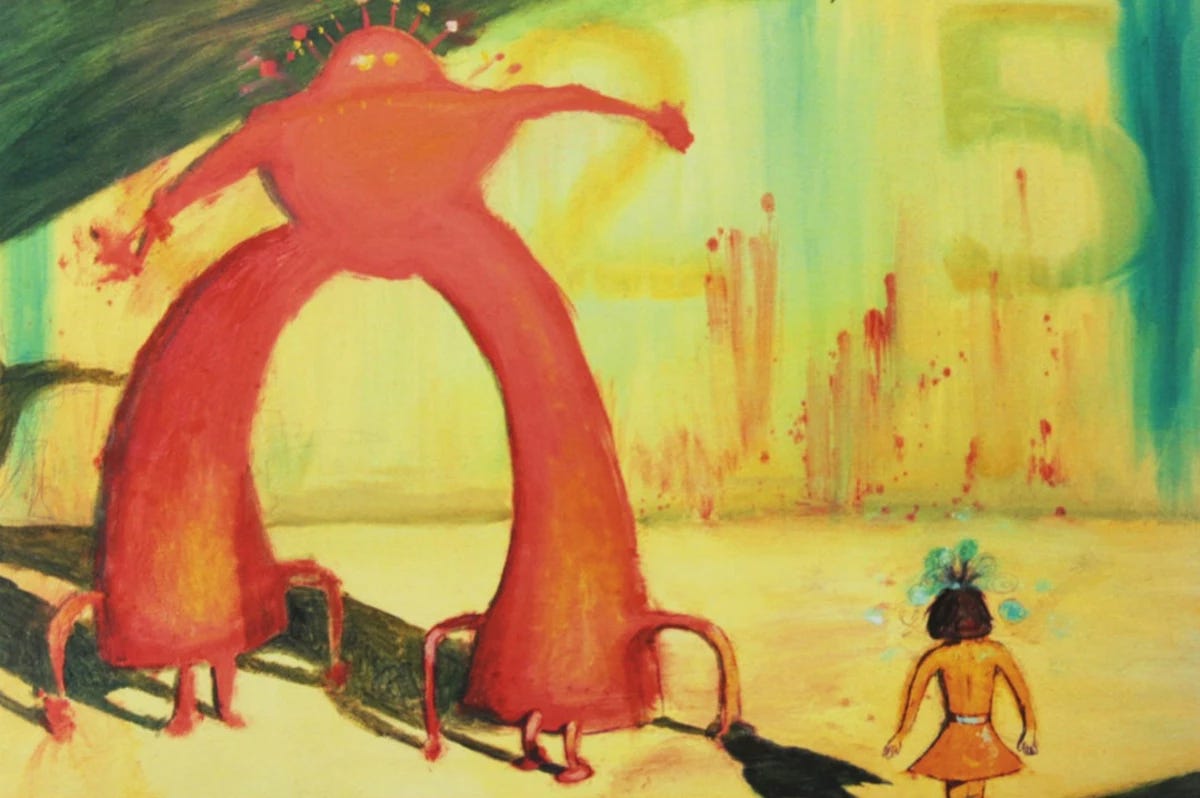
The Flaming Lips, Yoshimi Battles the Pink Robots (2002). “Those evil-natured robots / They’re programmed to destroy us / She’s gotta be strong to fight them / So she’s takin’ lots of vitamins.” Yes, I know this song is widely interpreted as a metaphor for fighting cancer, but in the age of AI I can’t help but think we could use a Yoshimi of our own. (And in my opinion, cancer is an apt metaphor for AI).
It is by no means the Flaming Lips’ most expansive album (that would have to be Embryonic), or their most experimental and daring (that’s still, to this day, Zaireeka, simply because recording four different albums meant to be played simultaneously is hard to top). But as an album that blends the band’s penchant for the catchy and heartfelt with their unquenchable thirst for the cosmic weird, Yoshimi Battles the Pink Robots is their par excellence. If anyone asks where they should start with the Flaming Lips, normally I tell them Yoshimi.
Granted, the robot-fighting premise of this “concept” album more or less disappears after about the fifth track, but when it drops away we’re left with the same naive questions that Wayne Coyne seems unable to stop asking. “Oh, what is love and what is hate?” he asks on “In the Morning of the Magicians,” “And why does it matter?” It’s an almost trite line of questioning, especially for songwriters, but it’s asked with such sincerity that dismissing it seems churlish.
12 Monkeys (season 1), created by Terry Matalas and Travis Fickett (2015). In a world full of half-assed, ill-advised unnecessary TV adaptations, be SyFy’s 12 Monkeys. Terry Gilliam’s 1995 original is a tremendous film, with his gonzo fingerprints all over them. Fickett and Matalas’ adaptation is rare in that you can make the case for why it should exist. The art direction, dialogue, and acting are all very strong, each doing their part to carry the story forward. This was rare for a SyFy show in the mid-2010s. Though all the performances are solid, Emily Hampshire’s portrayal of a brilliant but severely unstable scientist and biotech scion is mesmerizing to watch: at turns vulnerable and pathetic, capable of seeing and knowing what nobody else can, then suddenly menacing and unhinged.
The show also got its fair share of easter eggs for those familiar with the origin of the material. One of the characters’ last names, for example, is Marker. It would be obtuse to claim this is anything other than a reference to Chris Marker, whose short La Jetée was Gilliam’s inspiration for this interpretation. Finally, it manages to actually bring something original to the subject matter. Namely examinations of history and morality through the prism of time travel that pivot from and elaborate on the ‘95 film. Who knows if subsequent seasons successfully maintain this, but so far it’s been a rewarding watch.
“Gramsci’s Ashes,” by Pier Paolo Pasolini (1957). Whenever I feel like my writing reserves are approaching empty, I read “Gramsci’s Ashes.” Pasolini’s talent at finding words and images that span the gaps between political defeat and personal tragedy really is unmatched. Taking this further, there are few locations, in the Italian context, that embody this same gap better than the grave of Antonio Gramsci at the Cimitero Acattolico in Rome.
Despite Gramsci’s atheism, Pasolini, a Catholic, clearly saw a certain injustice in the Marxist thinker’s interment in a non-Catholic cemetery ( “Here you lie, exiled, with cruel Protestant / neatness, listed among the foreign / dead: Gramsci’s ashes…”). Not because he thought Gramsci should have been a better Catholic, but because he insisted that there is in fact a gothic, earthy spiritual connection running through revolutionary commitment. I, a lifelong Marxist and a convert to Judaism, don’t disagree, though I can’t force a particular theology on the communist vision anymore than Pasolini could.
“I know that I am bound to it, in the heat / of instinct, of aesthetic passion / attracted by a proletarian life - / prior to you - it’s for me a religion…” The author is being both literal and metaphorical here. Most of the time, when writers attempt this, it comes off as either confusing or hacky, most often both. Not here.
Header image is Wayne Coyne’s cover art for Yoshimi Battles the Pink Robots (2002).
I am a simple man. I see Flaming Lips, I click. Also, is Worms of the Senses a Refused reference? If so, did we just become best friends?