

Stolen Time
An office. Politics. An office polyptych.

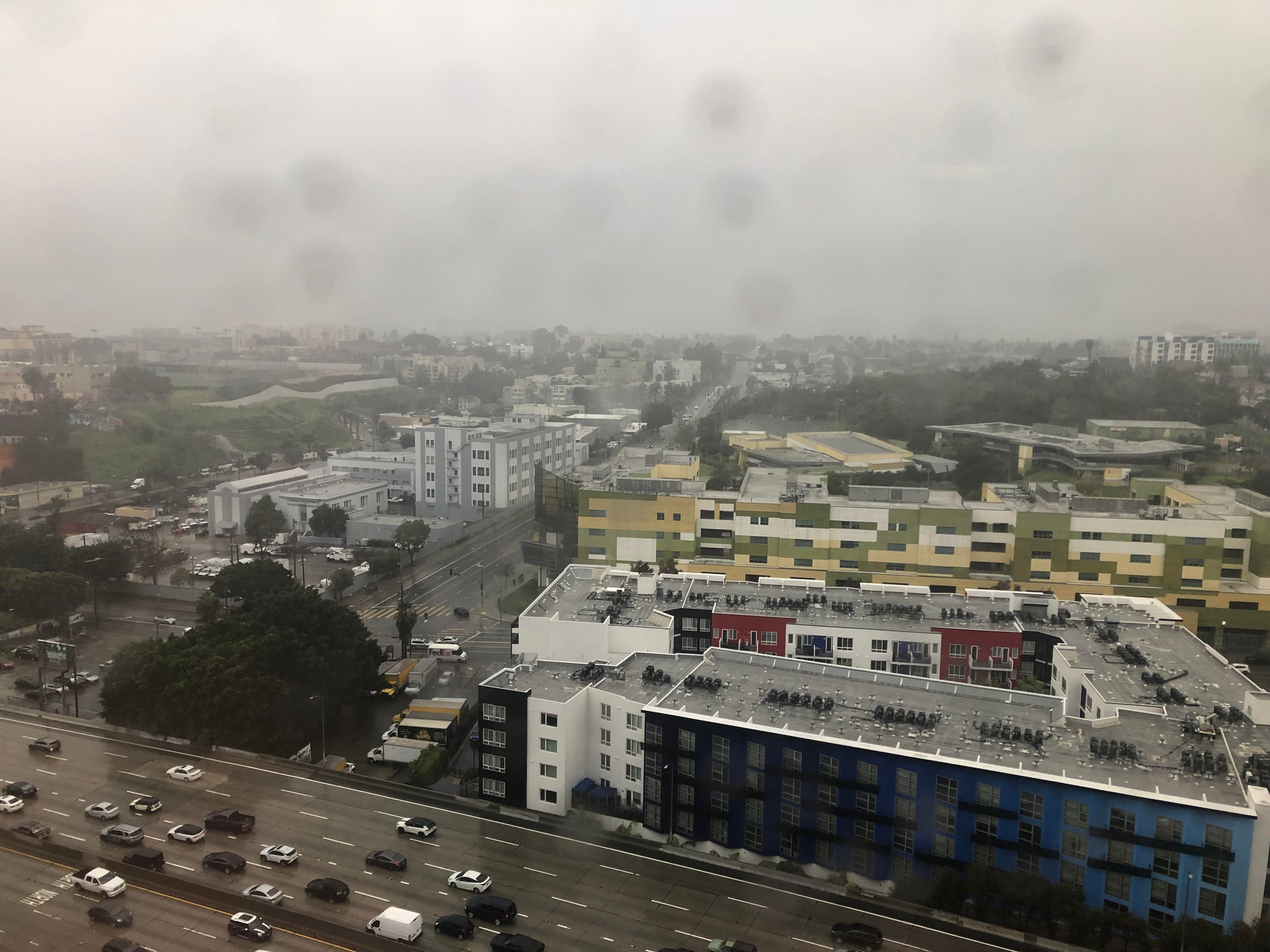
The impulse. To break myself out of the creative doldrums that come with the winter. This is the time of year when everything and everyone in Southern California loses their bearings. Angelenos aren’t used to the mild cold, or the rain. We could be if we wanted to: both arrive every winter. Unfortunately we spend the rest of the year acting as if these don’t exist. That they’ll never return.
When they do, we are taken by surprise, disoriented, removed from all sense of geographic coherence. Traffic loses all semblance predictability, the wet turns the freeway into Fury Road. People stumble around in forty degree weather wearing shorts, sandals, and t-shirts, as if they can will back the warm weather.
Everything outside feels alien, as if the buildings are standing simply because they’re too frightened to do anything else. Nothing belongs. Everyone gets a little dumber and a little meaner.
The decision. In an environment like this, writing feels even more acutely like a waste of time. I know it isn’t, but the feeling is unavoidable. Like I’m simply burrowing deeper into the torpor. I’ve been struggling with a handful of projects lately, but the LA winter ensures I get stuck.
If I can’t write, then I can draw. But drawing, like writing, takes time.
The challenge. Like most people, the lion’s share of my waking time is spent performing mindless tasks so that I might receive payment. Most of that payment then goes to housing, food, and bills. Payment that might go to something worthwhile or rewarding? Out of the question. Who do you think you are that you even ask?
The rules. If I’m stuck at work all day, then drawing will have to be done on company time. In that spirit, I can only draw with and on items found in an office. Pencils. Pens. Markers. Paper from the copier or index cards in the cabinet.
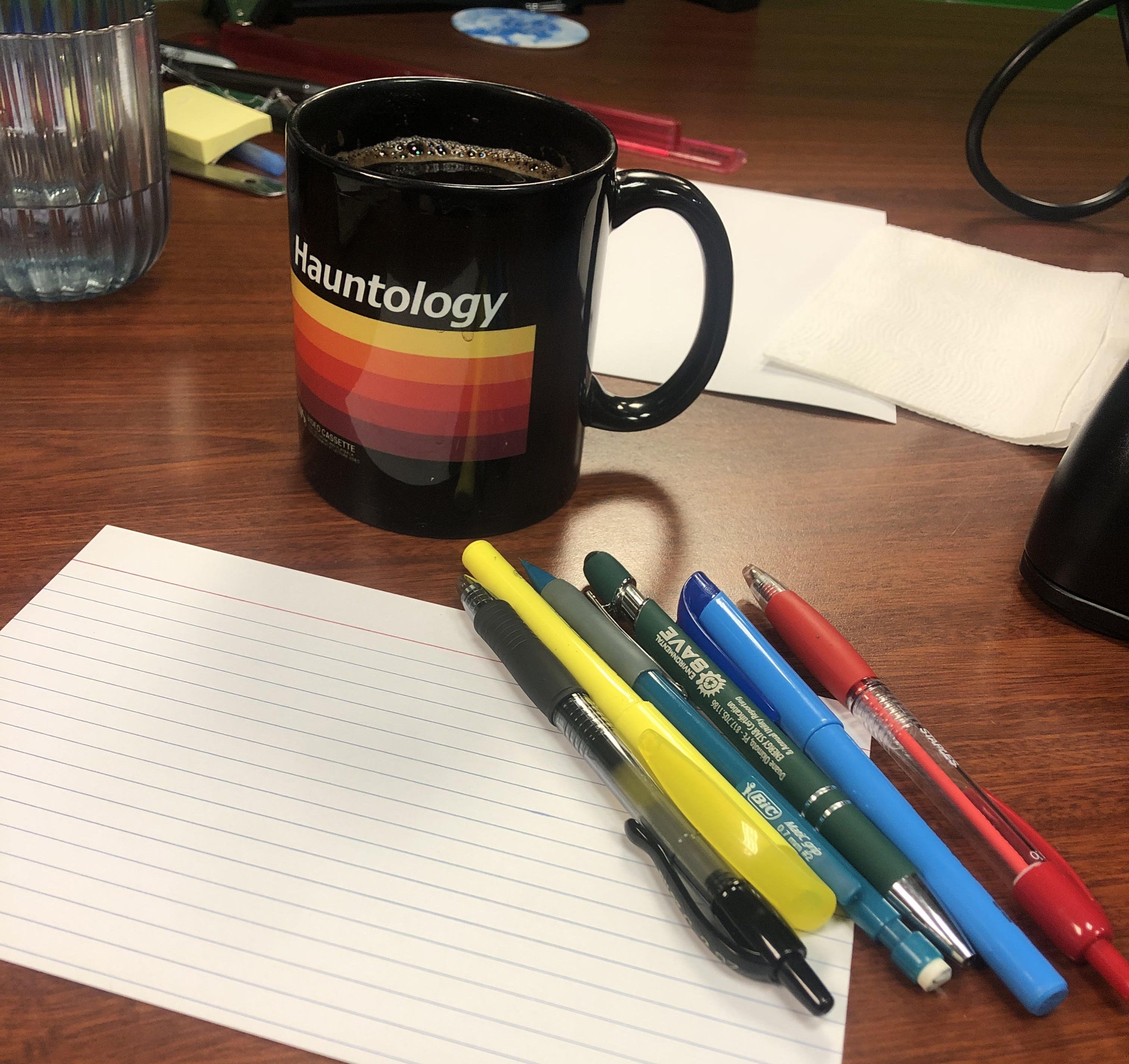
The results. What becomes an obstacle quickly becomes an interesting medium. Drawing doesn’t feel textured enough? Put it through the scanner and print it. See what kinds of weird artifacts show up in the background. Shading? Figure out how to shade with a ballpoint pen. It’s certainly possible, though there are tools (watercolors, for example) far better suited. Lean into the mess, the imprecision.
One of the interesting things about creating in the cracks and crevices of time is that you have to play with whatever thoughts you can access here and now. No chance to plumb the depths of your brain, to decide what to think about. As with the materials, just use what’s already there.
It’s a bit haptic, a bit automatic. Let it come, without thinking, without regard for quality or coherence, and just go with it. The viewer will find (or impose) their own meanings. Bank on what Deleuze and Guattari say about art, that it’s less about representation and more about a “bloc of sensations.”
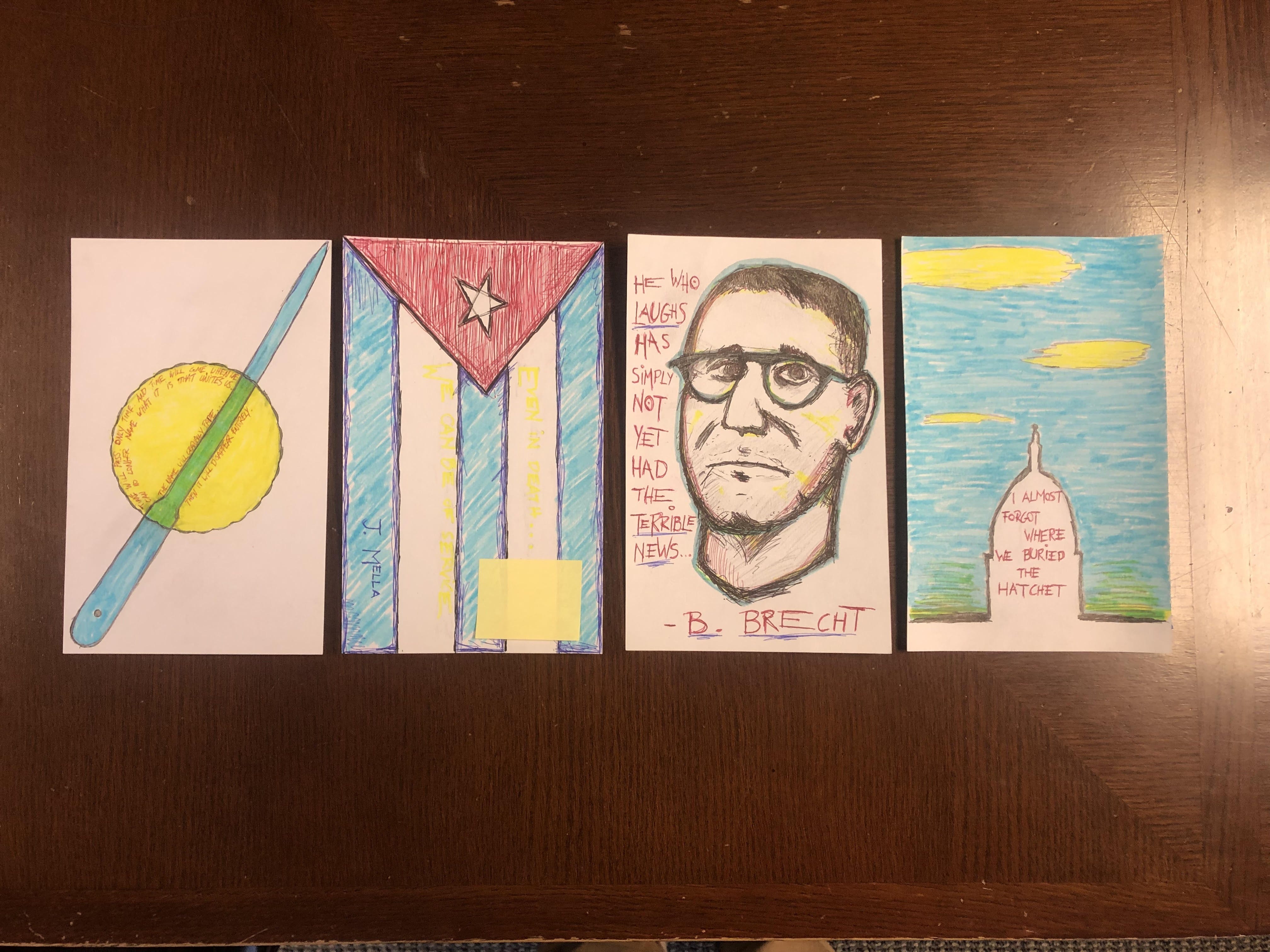
Four pictures. A loose color scheme and thematic coherence (both of which were often formulated later). Not a diptych or triptych, but what I read somewhere is called a polyptych.
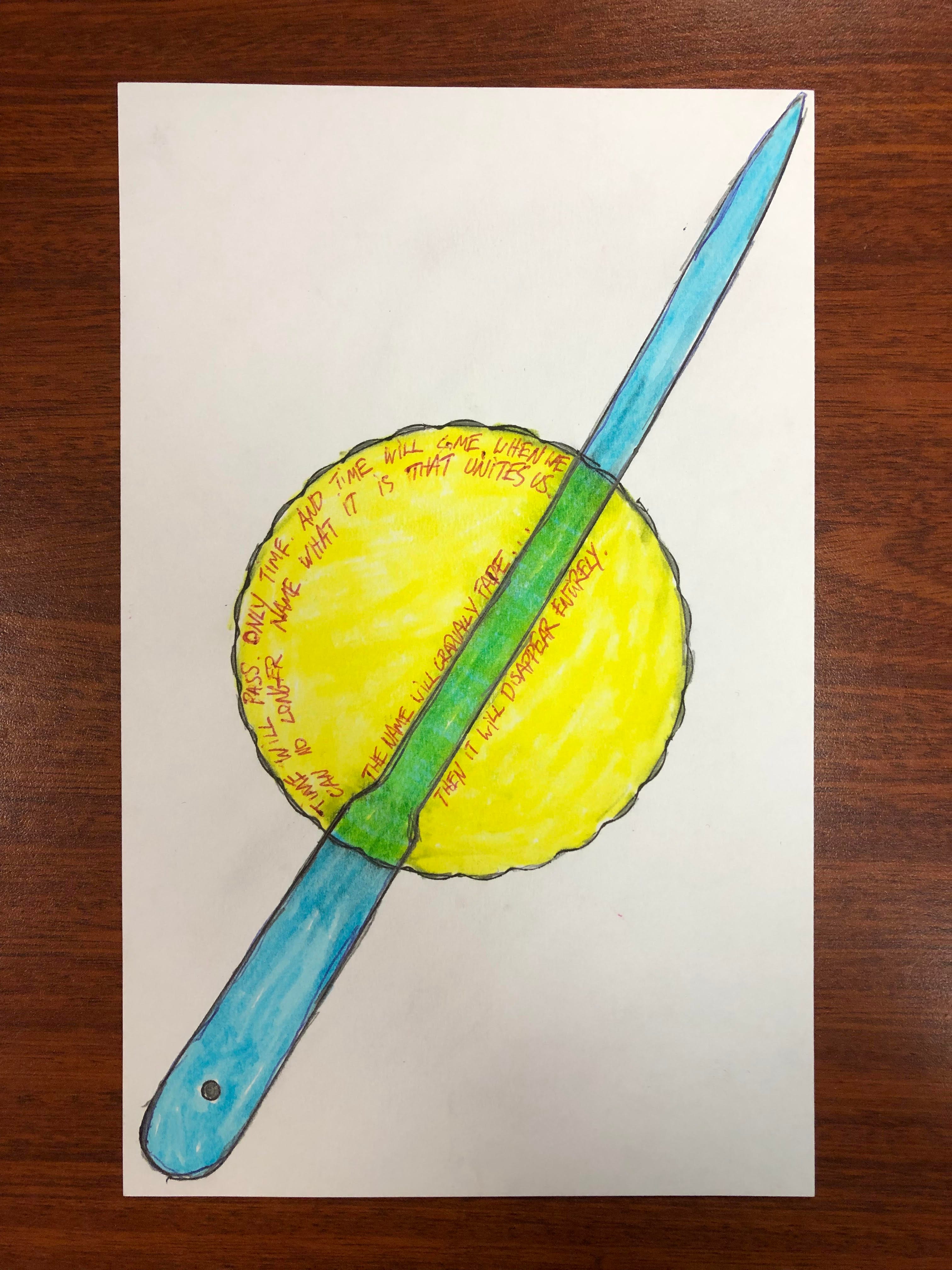
First picture. The catastrophe of forgetting, in the shape of a letter opener and a drinking cup. Childlike tracing with pencil and pen, a bit of coloring with blue and yellow highlighters.
The quote in red ink is from Alain Resnais’ Hiroshima, Mon Amour (1959). “Time will pass. Only time. And time will come when we can no longer name what it is that unites us. The name will gradually fade… then it will disappear entirely.”
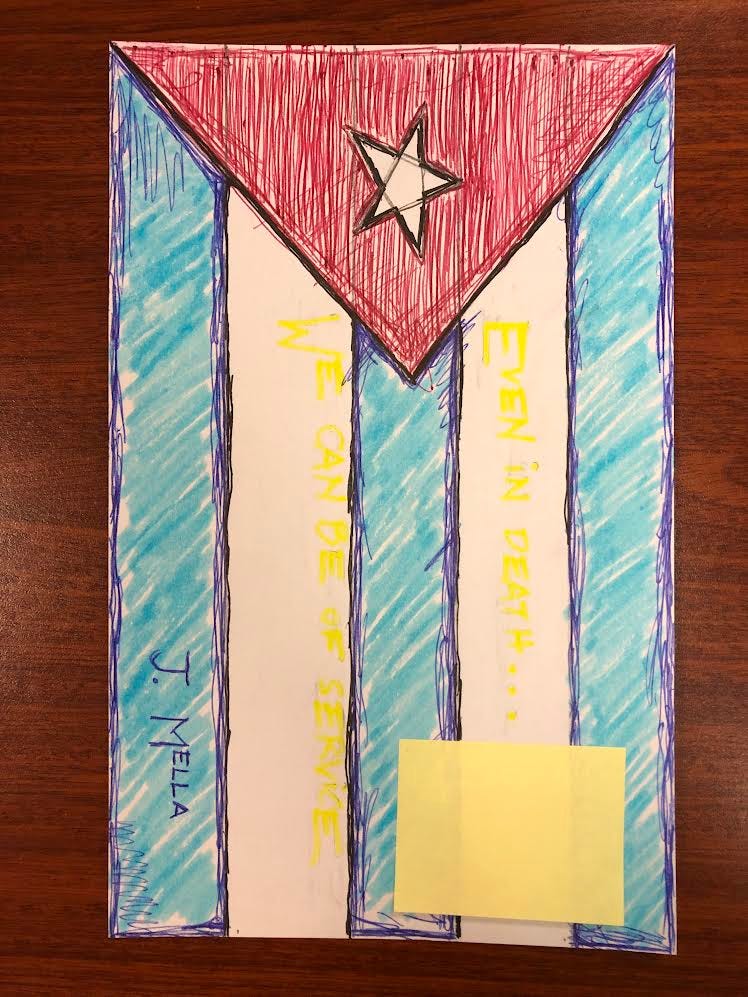
Second picture. Cuba has, obviously, been on my mind. Something about how Trump’s embargoes aren’t only creating a full-on humanitarian crisis in the country but clearly gearing up to deal a death blow to the most enduring socialist experiment in the hemisphere.
The quote, deliberately faint, is from Julio Mella, the slain Cuban communist leader: “Even in death, we can be of service.” I’m clearly looking for a morose kind of hope.
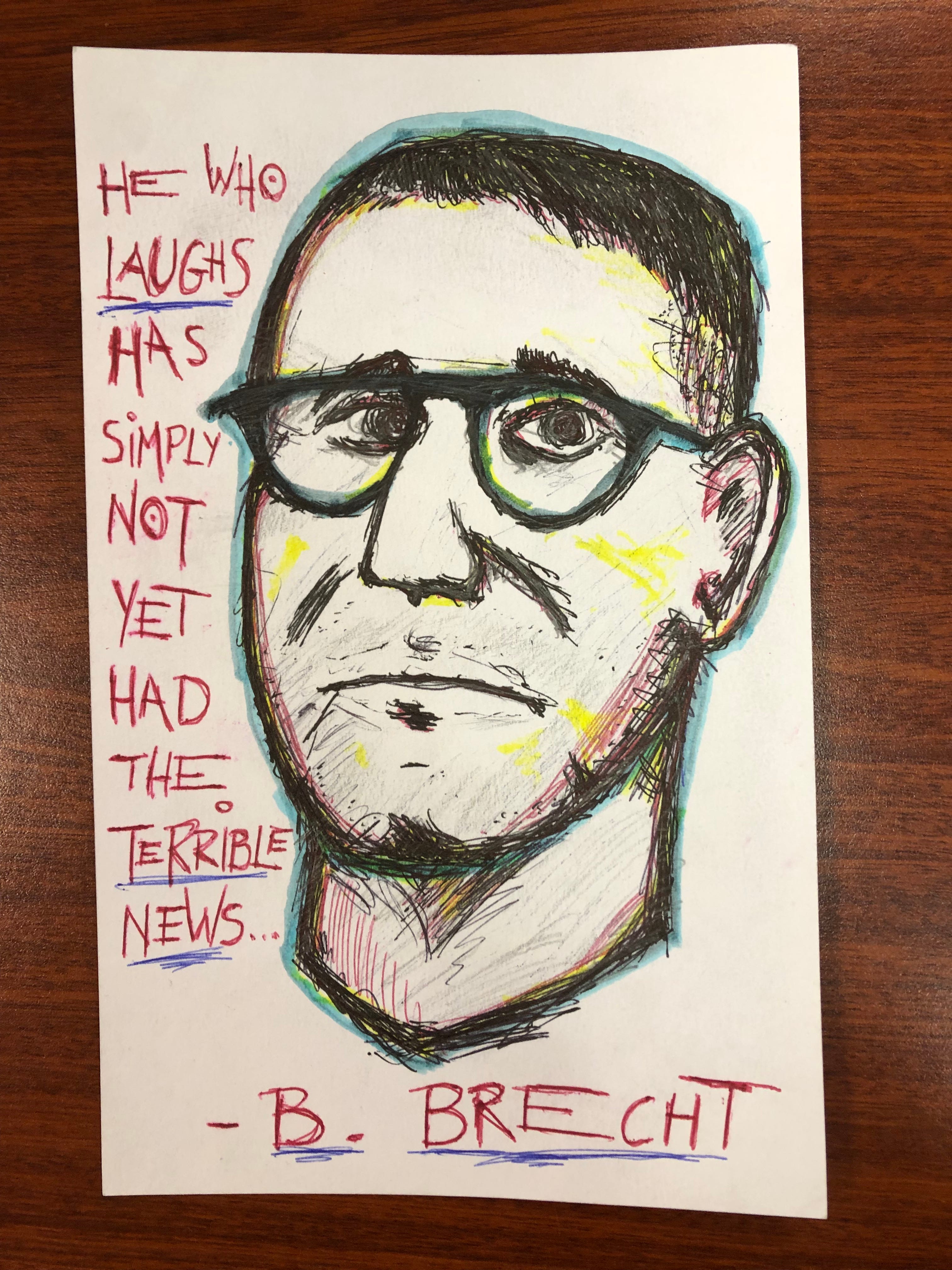
Third picture. Bertolt Brecht, drawn on his birthday (February 10) and one of his memorable (however bleak) quips. There are many others I could have chosen, though given the tone of the above, it’s probably understandable why I landed on this one.
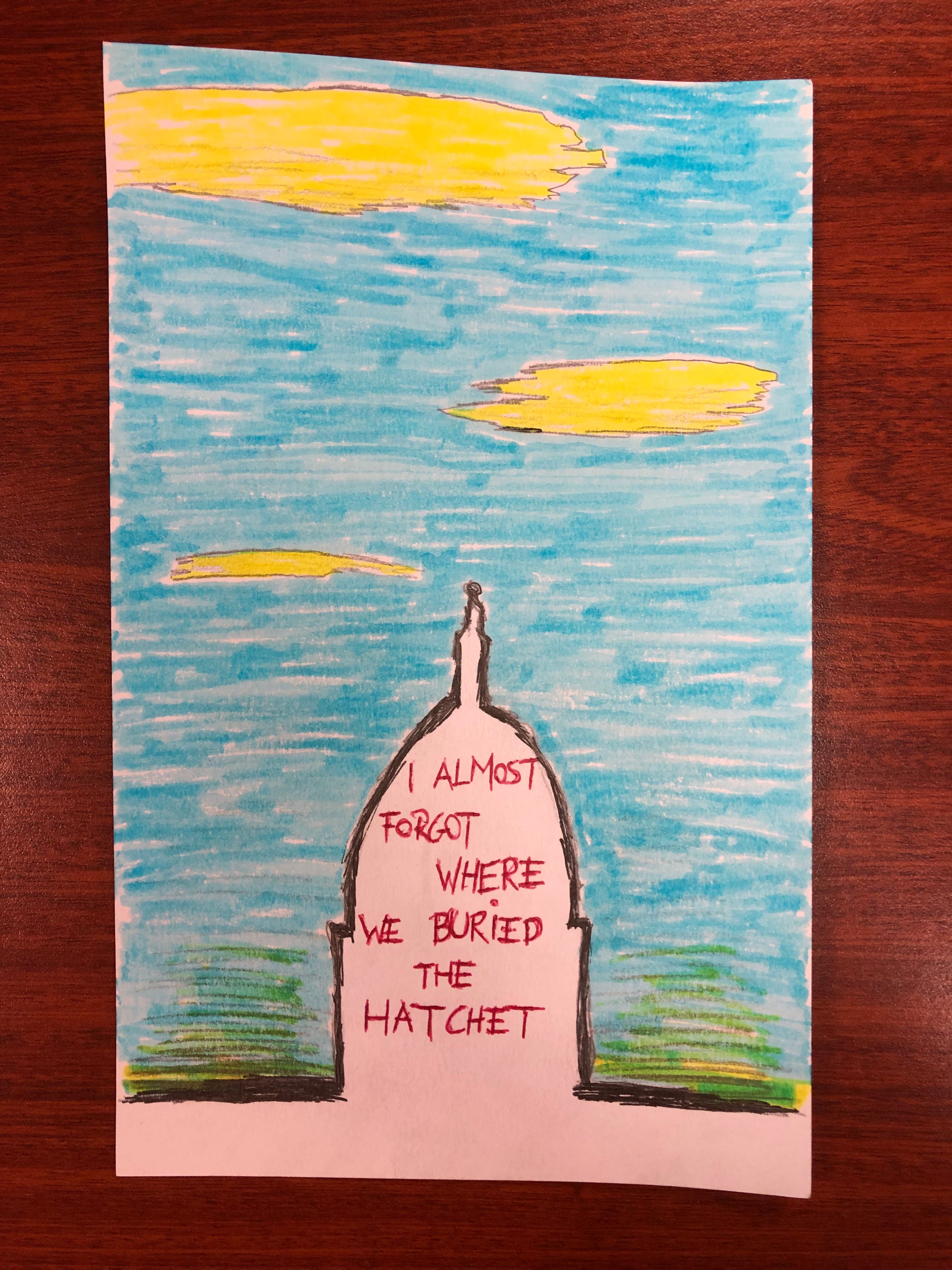
Fourth picture. The outline of St. Paul’s Cathedral on the River Thames in London. The words are from Robert Wyatt’s “Was a Friend.”
Been listening to a lot of Wyatt lately. Past that I couldn’t say why this particular line came to me while I was moved to draw St. Paul’s. While English of course (arguably one of the most effortlessly English communist recording artists around) Wyatt only spent maybe half his career living and working in London (the other half is split between Lincolnshire, Surrey, and various parts of Catalonia).
Again, I acted on instinct. Pictures and words came to mind, I sketched them, adding detail as I was later moved.
The fallout. Of course, the cruel winter continued. Nothing really lifted. At least, none of the rain or stupidity or meanness did. But the process did seem to make it all a little easier to tolerate. Stealing time back is a better therapy than most other forms.
All images are by the author.
Worms of the Senses
(what I’m seeing, hearing, and reading…)
Seeing
At Land, written and directed by Maya Deren, (1944)
Being John Malkovich, directed by Spike Jonze, screenplay by Charlie Kaufman, (1999)
Hearing
Charles “Poppy Boy” Walker, Dirt Bike Vacation (2024)
Robert Wyatt, Old Rottenhat (1985) and Dondestan (Revisited) (1998)
The Flaming Lips, Peace Sword (2013)
Reading
Selected Poems, by Bertolt Brecht (1947)
Anarchy & Beauty: William Morris and His Legacy, 1860-1960, by Fiona MacCarthy (2014)