

The Box
No thinking outside it.

I’ve got a review of AJA Woods’ solid book The Cultural Marxism Conspiracy appearing at the Los Angeles Review of Books later this week. Keep your eyes peeled for it.
Nobody says “think outside the box” anymore. There are a few reasons for this. Yes it became overused. Yes it was always a trite, stupid example of corporate culture trying to make itself feel dynamic and free. But mostly it’s that, by now, the whole logic of the phrase has been suffused into the same stifling culture that spawned it.
This (obviously) isn’t to say that corporate culture fully rewards initiative or creative thinking. Far from it, in fact. It simply means that the whole parameter has transcended itself, that it’s figured out a way to trap you in a boundary that never stops moving. The image of the “non-traditional” workplace with no cubicle walls, no dress code, flexible work-from-home arrangements and ping-pong in the breakroom was never actually meant to free you up. Just another example of desire capture. The lack of walls allow for better monitoring of productivity, work-from-home allows the shame of not working to follow you home, and the ping-pong ball has a censor in it to track how much time you spend away from your desk. No matter how creatively you think, that creativity can always be captured and redirected into something else. “The Box” is everywhere and nowhere.
My work recently held a meeting where we were shown how to use the company’s new in-house artificial intelligence program. I tuned out. We were asked to follow along on our laptops. I checked my email instead. That morning I had listened to a report of a small town along the Tennessee-Mississippi border where the air has been made toxic by a data center for Elon Musk’s xAI. These stories are rampant. The idea of using this technology, let alone with the enthusiasm of the twits at corporate (some of whom are probably already suffering some sort of AI psychosis) feels anathema. Like I’m contributing to a slow war crime.
I won’t be in this job much longer. I’m starting graduate school in the fall. Viz-a-viz AI, this feels a lot like jumping off the Titanic into the Twin Towers. I’ve read the stories of college students arriving without basic reading comprehension skills, who will no doubt be far more tempted to turn to Claude to write their papers for them. If things stay stable enough for me to start teaching in several years time, how will I handle this quandary? Will I dig my heels in and threaten to flunk anyone caught using AI? It’s not their fault the schools stopped teaching phonics.
Even with how quaint it sounds to believe I could sniff out the use of AI every time, this feels like punishing them for the world they grew up in. Some of these students are already so scared of being caught using AI that they are putting their papers through AI programs designed to find text that looks like it might have been written by AI. Teachers are using the same programs, which often mistakenly flag genuine human writing. You no doubt see the problem.
Last week, the Guardian reported that the Atlantic Meridional Overturn Current is predicted to collapse much sooner than previously thought. The circular streams that bring warm, tropical water to Europe and the Arctic, that has bolstered the weather patterns and seasonal rains for half the planet – and has for about twelve thousand years – will no longer reach where they once did. The eastern half of North America and most of the European continent will descend into erratic extremes of uninhabitable cold and inhospitable heatwaves. Farming crops will become impossible in some areas. Wildfires, floods, droughts. Climate refugee will become a reality for millions who thought “it could never happen to us.” And it’s likely to have all played out by the year 2100.
Unless, that is, we manage to put the brakes on the warming of the planet. 1.5 degrees Celsius is a threshold we’ve as good as crossed by now. Pulling back from 2 degrees is, in theory, feasible. In theory. If the priorities of the global energy grid are radically shifted.
As it looks now, that’s not happening. Not just because the world’s most powerful governments are determined to suck every ounce of crude out of the ground and spew it into the atmosphere. Google’s energy demands went up by 50% in the past five years, largely thanks to its use of AI. The largest data centers generate an immense amount of heat, warming the ground and air around them by an average of 9 degrees Celsius. Burning through anywhere from 50 million to 3 billion watts every day, these centers combined already consume more energy than most small countries, and are expected to make up more than 10% of global energy consumption in the next four years.
This will, of course, only increase the demand for coal and gas. All so we can do not less, but more, so that work can be not easier, but busier, so that our tasks can be less creative, less mindful, more tedious than ever before. I’m sure some of us could have said something about this at the AI meeting. We likely would have lost our jobs for it. Just because you can’t see the boundaries of the box doesn’t mean they aren’t there. I’m starting to think the only time we can really see them is when they’re on fire.
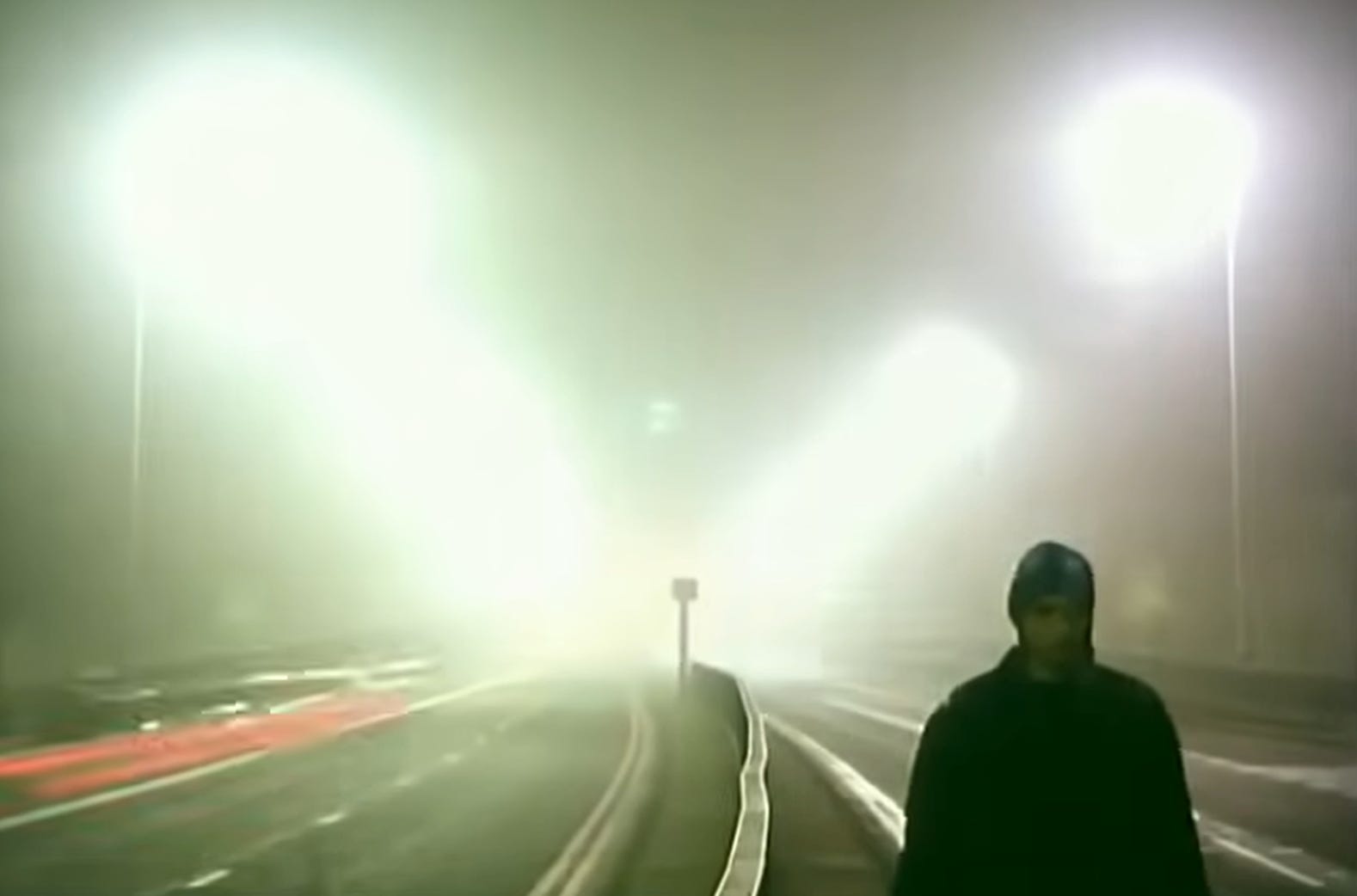
Header image is a still from the video for Orbital’s 1996 track “The Box.”
Worms of the Senses
(what I’m seeing, hearing, and reading…)
Seeing
Ratcatcher, written and directed by Lynne Ramsay (1999)
Erik Satie: Things Seen To the Right and the Left, written and directed by Chris Hale (1992)
Hearing
Tinariwen, Amassakoul (2004)
The Gun Club, Fire of Love (1981)
Reading
Search for a Method, by Jean-Paul Sartre (1957)
“Reading Stuart Hall for the Climate Crisis,” by Casey A. Williams (The BREAK—DOWN, 2025)