

The Psychedelic Empire
The psychonautics of death and domination.

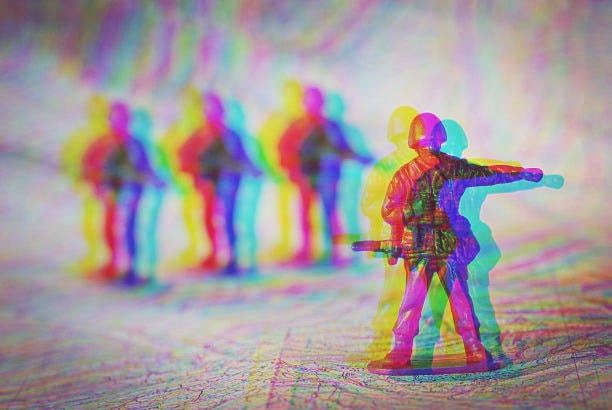
In two studies funded by the Department of Defense (DoD), 186 service personnel with PTSD will likely next year undergo multiple sessions of MDMA-assisted therapy. – Mattha Busby, “Active-duty US soldiers to receive MDMA therapy for PTSD next year,” Guardian, April 30, 2026
The Army’s on ecstasy, so they say.
I read all about it in USA Today.
They’ve stepped up urine testing to make it go away
‘Cuz it’s hard to kill the enemy on ol’ MDMA.
– Oysterhead, “Army’s on Ecstasy”
Something was pulling down the clouds. That’s what I remember most vividly…
It was March, in the Mojave Desert, not far from Joshua Tree National Park. It’s easy to understand why this area is a favorite among fans of psychedelics. Everything feels so eternally sprawling out there. More the same but without any repetitions whatsoever. Endless combinations of desert valleys and mountains and sky swirling into one another, the strange flora and fauna running along their edges. Every horizon is a different encounter with the perpetual expanse. Different depths of infinity. Even the particular silence of the Mojave feels like it’s introducing you to a new level of quiet.
It being March, the temperature hadn’t yet reached into the triple digits. The cool breeze was almost constant. Sprinkles of rain would spit down on us, and in our given state, each one felt like a tiny, gentle caress on our skin.
The “fractals” of a psilocybin trip are well-known. Almost anyone who has had one will have had some experience with them. It’s also been reported as a common experience with LSD, mescaline, MDMA, even cannabis. The part of our visual cortex that can “see” things geometrically goes into overdrive. The shapes and angles can engulf and sweep up what we see around us.
I am not one of those people who believes everything we go through during an altered state is by necessity some kind of revelation. That said, there is a reason that monks ascribed sacred meaning to geometric shapes, why they thought the math that explained how the universe stayed intact through its movements could also explain something sublime that we otherwise couldn’t access.
This time around, it was the clouds. With the light rainstorms passing overhead, the normal big empty of the sky was filled with gargantuan white masses floating over us. It is remarkable to realize that for all their apparent weightlessness, the biggest clouds can weigh over two million tons.
You’d think they would fall. And perhaps inevitably, they were. Laying on the desert floor, my friends and loved ones occasionally chattering around me, I was transfixed by the clouds. In the swarm of triangles and hexagons and rhombuses, the clouds looked as if they were plummeting downwards, spiraling down into the basin to smother the hundreds of miles beneath it. Tons of mist surging to fill the dry, empty air around us.
It never did of course. But with the defenses of my ego unraveled, I found myself welcoming this cosmic collapse. Though it would crush us and everything around us, I somehow knew that we would also emerge from it. Everything drastically transformed. Nothing the same. But so what? The collapse is cataclysmic. So is utopia.

It would seem that the US military machine is finally getting wise to this. Just in time for its own irresistible decline. The medical establishment has long known that psychedelics have a therapeutic side, and this awareness is finally translating into shifts in public policy. It probably goes without saying, however, that there is something utterly ghoulish in the proposal that MDMA could be administered to soldiers, healing them from their physical and psychic trauma just so they can go out and kill all over again.
To be clear, and lest this be misinterpreted: yes, of course soldiers deserve access to everything and anything that can heal their physical, mental, and emotional wounds. Ultimately, they aren’t the ones designing the systems and policies that send them to kill and be killed. (One of the reasons GI resistance in Vietnam was so powerful) No, the ghoulish part is the end goal of the psychedelic healing, the instrumentalization of both the psychedelics and soldiers’ mental health for the sake of maintaining domination over large parts of the globe. What could be access to real relief instead becomes a mechanism for repeated re-traumatization.
There are certainly plenty of others who see the wild contradiction at play here, and from several angles. Even on a simple aesthetic, vibes-based level, none of it makes sense. The psychedelic experience still drums up impressions of harmonious ecstasy, peaceniks and hippies. The kinds of standpoints that expand the mind precisely to evolve past the need for warmaking and systemic repression. The acid part of acid communism.
That was only ever part of the history. LSD wouldn’t have found its way into the zeitgeist of postwar America if not for the MKUltra program, which synthesized large batches of the drug as government scientists used it to liquefy the brains of unwitting test-subjects (which included soldiers).
Dig far enough through the history of MKUltra during the 50s and 60s and you’ll find strands of Operation Paperclip, the covert recruitment of former Nazi scientists into the US government. Without them, the US would have probably never gotten to the moon. Nor would some of the sadistic experiments notoriously conducted by the Third Reich found continuity in the disavowed, top-secret corners of American intelligence. Techniques developed in concentration camps were refined in CIA experiments.
That the counterculture found its own use for the mind-bending, oceanic experiences of psychedelics proves, in many ways, that any use value can be turned on its head given the right circumstances. The CIA and US military saw the plasticity of the mind as an opportunity to create a pliant subject, willing to carry out the aims of the state without question. Young people willing to experiment on their own saw a chance to better grasp visions of peace and love, to instill their possibilities into a consciousness pushing against the strict, gray enclosures of the Cold War. Neither outlook was inherent nor extrinsic to the nature of psychedelics themselves. Like technology, the psychedelic experience has no moral leaning, but is imprinted by the aims and circumstances that shape it.

We could feasibly say that the US’ relationship with psychedelics (and other consciousness-altering substances like cannabis) has been a push and pull between these two coordinates. Currently, though, it seems to be acid fascism that has seized the moment, what with Joe Rogan mugging behind a doddering Trump as the latter signs an executive order loosening restrictions on the use of ibogaine and other drugs in the treatment of mental illness.
Once again: on the surface, a Good Thing. Until one takes into account the far-right’s conception of mental illness and what it means to heal, to “get better.” What does this mean in the context of more than a trillion dollars in healthcare cuts? Or the economic chaos that is pushing so many into financial stress, dangling the threat of homelessness or worse over people’s heads? What of the persistent criminalization of homelessness, or addiction for that matter, given that the two are so often comorbid with mental illness? In this conjuncture, are psychedelics an effective treatment, or merely a surface level palliative?
On a recent episode of the Lepht Hand podcast, the hosts Emma Stamm and Craig (also from Acid Horizon) had on Sujit Thomas, a researcher working in “psychedelic thanatology,” studying the use of psychedelics in helping the terminally ill make peace with coming death. The idea is intriguing, and more than a bit attractive. The use of psilocybin and LSD with patients in their final moments has been a growing practice among death doulas in recent years, though the practice obviously goes back much further.
The three discussants took up some difficult questions. Are the psychedelic thoughts that emerge or are prompted in a treatment session access to a deeper truth or merely hallucinations? To what degree is this simply an imposition of spiritual or religious eschatology on a rational mind feeling natural feelings about its end?
One can’t begrudge anyone’s desire for any help in coming to grips with that big finality. None of us truly know what’s on the other side, and oblivion is awesomely terrifying. But the most pressing question the three discussed is whether psychedelic death therapy can play a truly constructive role in a necropolitical order.
We live in a world where, increasingly, some are permitted to live while others are deemed disposable. Some of these are people who can’t stay within restrictive, sometimes impossible, behavioral boundaries; boundaries that force people to live immiserated or inauthentic lives. Then there are those who are pushed toward death simply by dint of being born. Look at the child death rate in Gaza and you’ll see what I mean.
In Canada, there’s controversy over the proposed expansion of assisted suicide laws. Last year, British parliament debated a “right to die bill” that confounded many who had historically been steadfast supporters of the right to assisted suicide. With austerity in both countries chipping away at the quality of life, legalized suicide might simply be an easy solution for a system that isn’t willing to provide the conditions for a robust lifeworld. Similarly, anything that can content people with their inevitable demise just might allow a whole class of people to get away with social murder.

And yet, I cannot in good faith dismiss hope in the psychedelic dimensions. The point here isn’t that expansion of consciousness is futile (nor even that it requires the assistance of mushrooms or acid), merely that unless it reaches for intersubjectivity, for transforming the world in concert with the mind, it won’t be of much use.
A system of organized death inherently sees consciousness as something individual. Anything outside the human’s conception of self is occupied either by some harsh vitalist force we can never fully know or merely by a void. A system of life, on the other hand, that takes the building and perpetuation of life seriously, sees consciousness as a collective project. As did Hegel, as did Jung, as did Marx and Gramsci. Not for nothing did Marcuse see the psychedelic experience as a chance to dissolve the strictures that capitalist rationalization had imposed on the subject.
The order of death is ultimately an apocalyptic one, but as Evan Calder Williams argues, apocalypse can have more than one meaning. It can be as much revelation and redemption as catastrophe. The unknown, the contingent factor, is whether the conditions can be created for the latter to be turned to the former, both on an individual and collective register.
The fractals tell us as much. Give yourself over to the myriad, quick-cycling numbers and angles of psychedelic geometry, and you start to wonder whether if the quantum physicists are onto something, if some kind of pathway being shown to us, a glance into how the veil is pierced between different parallel realities.
According to some, there’s an infinite number of universes out there, with endless divergences in possibility. Which means that in at least one of them, there’s a number of soldiers, marines, sailors, and pilots whose psychonautic-therapeutic plunges have made clear the gap between their own dreams and the interests of those who told them that the way to safety was to kill others like them. That’s not to say they’re necessarily putting down the guns once and for all. Just that they’re now pointing them in the direction of those who gave them the guns in the first place.
Header image is stock photo.
Worms of the Senses
(what I’m seeing, hearing, and reading…)
Seeing
Ausfegen, Joseph Beuys (1972)
Hearing
Interpol, Turn On the Bright Lights (2002)
Boards of Canada, A Beautiful Place Out In the Country (2000)
Reading
Love and Terror: The Helter Skelter History of the Manson Murders, by Claudia Verhoeven (2026)
“Life of Intrigue,” by Rob Benvie (The Metropolitan Review, 2026)
“The Rise and Fall of Barboncino Workers United,” by Brendan O’Connor (Long-Haul, 2025)
good words here - as i was reading i was struck by the resonance with the LEPHT HAND episode, and then, there we were - appreciate it. i've been so disappointed by the lack of nuanced engagement with psychedelics from humanities scholars (usually they just drift towards bioethics or blunt hype-y/overly critical interventions), so it's encouraging to see this kind of work.