

Time, Time, Time, Forever Time
Repo Man’s (attempted) escape from history.


Quick reminder: today’s post is, in its full and complete form, available for paying subscribers only. If you like what what you read in the first (free) section, then please consider supporting my work.
I could also possibly be convinced to send you the text if you’re really interested, and if you’d be willing to send me a few bucks in some form or otherwise suggest a way to support my work. You know how to contact me.
Punk and the city of Los Angeles coexist at a peculiar intersection. There’s London and New York City at the moment of birth. There’s Detroit where the rage at the fringes of the hippy movement gestated. There’s Jakarta and Johannesburg and São Paulo and Beijing where so many other disgruntled subalterns put their mark on the genre. But LA shows up as a specific kind of city when punk needed a specific kind of nihilism.
This is where the settlers of Manifest Destiny showed up and realized that the only way to keep conquering was to jump in another ocean. Instead they went to war against Mexico. “A bright, guilty place” Orson Welles called it. And by the time Rodney Bingenheimer was playing the Sex Pistols for the first time on KROQ it was when the postwar bust had fully killed the idea that America might “take care of its own.” The inviting smiles of LA – where there had never been anything like a social safety net, where even its public transit system had been eliminated lest its people get any socialist ideas – gave way to some particularly menacing snarls. All the more nasty because the smiles were so bright.
I love writing about Los Angeles for the same reasons I still listen to Black Flag. Both exhibit, in their own way, a distinctly American form of late capitalist collapse. While LA can’t help but be honest about it – so thin is its “anyone can be a star” veneer – Black Flag embraced the ugly truth with aplomb. They also found different ways to do so through different incarnations of the group.
Black Flag’s music repeatedly shows up in the soundtrack of Repo Man (1984). A jilted Otto (Emilio Estevez) drunkenly sings “TV Party” next to the train tracks, not long before Bud (the brilliant Harry Dean Stanton) tricks him into stealing/repossessing a car.
Suicidal Tendencies are also a haunting presence in the film. “Institutionalized” plays in the background as Otto is kicked to the curb by his soon-to-be ex squeeze Debbi (Jennifer Balogun).
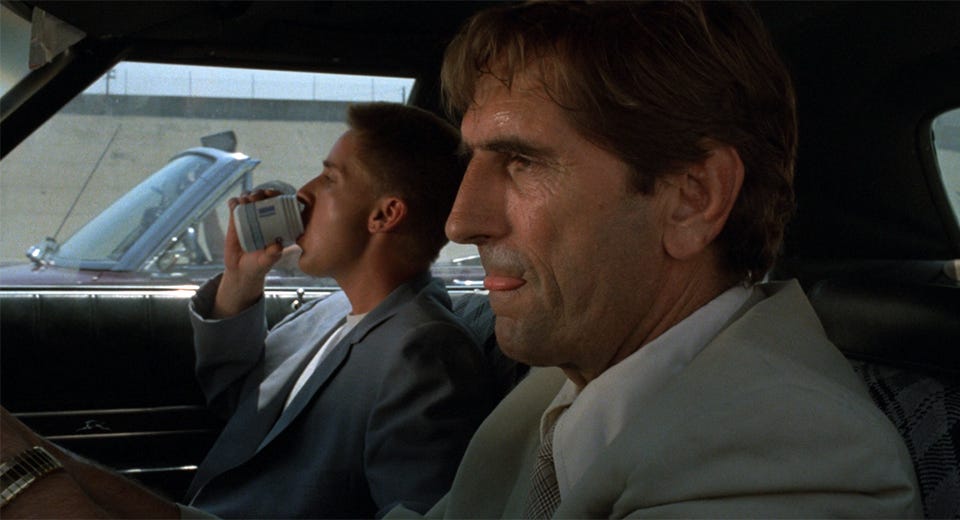
Then there are the Circle Jerks, dressed in leisure suits and playing a lounge version of “When the Shit Hits the Fan” in a swank bar (“I can’t believe I used to like these guys,” remarks Otto). Zander Schloss, who later that year would replace Earl Liberty as the Jerks’ bassist, plays Otto’s friend “Kevin the Nerd” with a deft kind of aimless stupidity. He argues to Otto that there’s a future in a fry cook job, even with no future anywhere else; certainly not in the stockboy job he and Otto just got fired from.
All of these punk bona fides are well-known. Not for nothing is Repo Man known as one of the best punk flicks ever made. But what exactly does this mean? By the time Cox started making his film, “punk” had been around the better part of a decade. It wasn’t the shock to the system it had once been. What’s more, in the world of Repo Man, punks aren’t exactly the ones in the know. Sure, they fancy themselves outside and against “respectable society,” but for the most part they’re about as aimless and trapped as Kevin thinking he can build a future from a series of dead-end jobs, or that mindlessly singing a 7-Up jingle is time well-spent. By the end of the film, Kevin is as senselessly dead as anyone else.
Welcome to Edge City
Genre is a slippery concept. While it’s not colloquially untrue that Repo Man is a “punk film,” as a descriptor of the film’s themes and devices it is imprecise. Pull the film up on any streamer and it will most likely be labeled “sci-fi.” Appropriate enough for a film that involves stolen aliens and glowing, flying cars. It’s quite common for film writers to call Repo Man a noir, or “neo-noir.”
In fact, noir just about covers what makes Repo Man a “punk film.” Just as film noir and pulpy, noir novels gave release to all the repressed fears and anxieties of mid-century America – the violence and intrigue that the mainstream vociferously shuns – so did the early punk movement become a space of expression for people who, either by choice or circumstance, existed on the jagged margins of precarity and dispossession.
They navigated markedly different settings. The undercurrents of early Cold War America looked and moved differently from those of the economic downturns of the 1970s. But both noir and punk adopted a gothic posture in relation to dominant narratives of smiling optimism and faith in the system. Both rubbed outside audiences’ noses in the lives and practices that optimism can’t account for and tries to externalize, villainize or explain away. Both stood with two feet firmly planted in the detritus of a capitalist modernity that denies it produces anything of the sort. Both stare back at that straight-laced, hypocritical world with sneering glee. For these reasons, both were frequently subject to denunciation or even censorship.
We are faced with plain proof of this in Repo Man when Otto returns to his parents’ home, initially repulsed by the idea of joining Bud in the cutthroat world of car repossession, hoping to get his hands on some money they once promised him. They’ll disappoint him. Which perhaps he should expect coming from two former hippies, now devolved into burnouts glued to their couch and television. Without looking away from the screen, they’ll absently tell him they gave it to an evangelical preacher on TV. Otto won’t yell or react with anger or even exhibit much in the way of shock. It would appear he’d half expected them to renege.
Before any of that, though, before he enters the front door of his childhood home, he’ll have to get off the bus that brought him there. “Edge City” it says on the front, and it very likely is the end of the line. Edge City doesn’t really exist. There is no Edge City in the LA area. The destination is an easter egg, the title of Cox’s earlier short film.
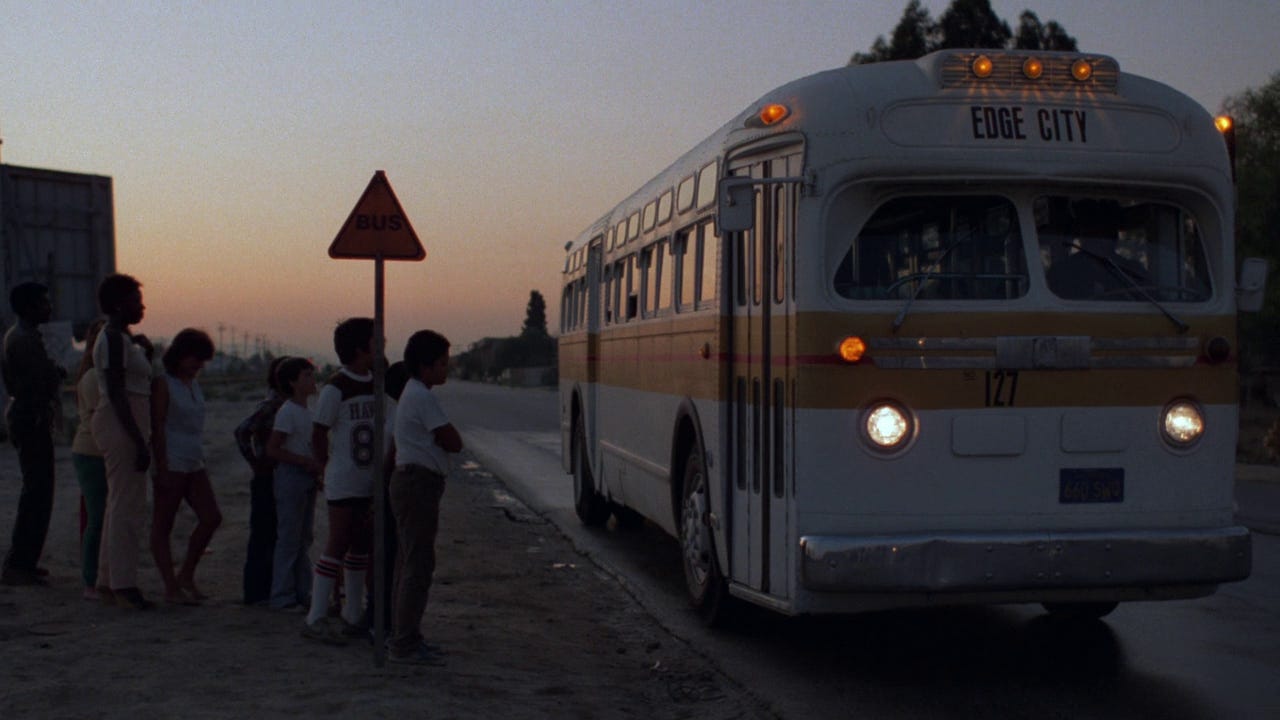
We’ll see this bus periodically return throughout the film. At this particular moment, it is telling us something about Otto, the directionless, disgruntled punk coming to beg is braindead parents for money because he can’t stomach the idea of a repo job. He and his family are, rather literally, from the edge of the film’s world. The periphery, the place that normally exists just on the outer limits of people’s sight lines. Hazy, unremarkable, and easy to forget.
There was, in 1984, another sci-fi neo-noir floating around in the pop culture ecosphere. Released two years before to polarizing reviews, Blade Runner was already becoming a staple of arthouse theatres and on its way to cult status. Though the two films are obviously radically different in tone and content, Ridley Scott’s cyberpunk staple also shares a method of storytelling with Repo Man, distinct to both noir and the various understandings of “punk” (whatever iteration).
